TL;DR: The Myrtle Beach vacation rental market draws strong buyer interest, but 2026 conditions — rising condo inventory, softening median prices, and extended days on market — mean the math deserves a careful look before you buy. This post walks through what the current data actually shows, and what questions to ask before committing to a rental investment.
The Appeal Is Real. So Is the Complexity.
Myrtle Beach draws millions of visitors each year, and that foot traffic has long made the Grand Strand one of the more popular markets for buyers considering a vacation rental. It's easy to see the logic: buy a condo or single-family home near the beach, rent it out during peak season, offset the carrying costs, and enjoy the property during your own downtime.
But 2026 looks different from the frenzy of a few years ago. Inventory is rising. Condo prices are softening. Days on market are stretching out. And the question most investors are quietly asking — is it actually worth it right now? — deserves a more honest answer than "location, location, location."
The data is worth reading carefully.
What the Myrtle Beach Market Actually Shows in 2026
The local MLS data paints a nuanced picture for anyone evaluating vacation rental potential in Horry County.
According to the Coastal Carolinas Association of REALTORS® MLS (April 2026), the median condo sales price in the Myrtle Beach core ZIP codes (29572 and 29577) was $208,500 in April 2026 — down 12.4% from $238,000 one year earlier. Year-to-date, the median condo price in those ZIPs is running at $200,000, down from $228,000 through the same period in 2025.
That price softening cuts two ways. It creates a more accessible entry point for buyers. But it also signals that the condo segment — which overwhelmingly drives the vacation rental inventory in this market — is under supply pressure.
The CCAR MLS (April 2026) shows the Myrtle Beach area had 1,475 condo listings on the market in April 2026, up 5.8% year-over-year. Across the broader Grand Strand, condo months supply held steady at 8.1 months in April 2026 — essentially unchanged from the prior year, and meaningfully above the 5- to 6-month range typically associated with a balanced market. That level of inventory gives buyers negotiating room, but it also tells you how many competing units a rental owner would be up against.
Days on market for condos in Myrtle Beach's core ZIPs averaged 142 days in April 2026. That's a long time for a property to sit. It reflects real buyer hesitation in this price tier, and it's relevant context for anyone estimating how quickly they could resell if the investment doesn't perform as expected.
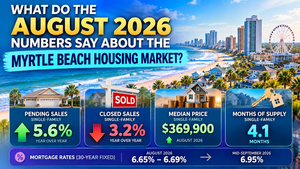
For single-family properties, the picture is somewhat steadier. The 12-month median single-family price across the Grand Strand was $365,000 as of April 2026 (CCAR MLS, April 2026), essentially flat year-over-year. Single-family months supply stood at 4.3 months in April 2026 — tighter than the condo segment, and reflecting more consistent demand.
Condo vs. Single-Family: Which Makes More Sense for Rentals?
Most vacation rental properties in the Myrtle Beach area are condos, and the data reflects that clearly. According to the 2025 Annual Report on the Coastal Carolinas Housing Market (CCAR MLS), Myrtle Beach recorded the highest condo market share of any submarket in the region at 73.3% of all closed sales in 2025. North Myrtle Beach followed at 55.4%.
That concentration matters for rental investors. Condos in resort markets offer lower entry prices and lower maintenance burdens, which makes them attractive. But high condo market share also means high rental competition — and the supply trend points toward more supply, not less, heading into 2026.
Here's a snapshot of current market conditions across key Grand Strand segments:
Grand Strand Rental Market Snapshot — April 2026
| Submarket / Type | Median Price (April 2026) | Months Supply | Days on Market |
|---|---|---|---|
| Myrtle Beach — Condo | $208,500 | 8.1 (Grand Strand avg.) | 142 |
| Myrtle Beach — Single-Family | $478,000 | 4.3 (Grand Strand avg.) | 117 |
| North Myrtle Beach — Condo | $342,900 | 8.1 (Grand Strand avg.) | 121 |
| Grand Strand — Single-Family (all) | $365,000 | 4.3 | 125 (12-mo. avg.) |
Source: CCAR MLS, Local Market Update and Monthly Indicators — April 2026
Single-family rentals in the Grand Strand can offer more differentiation from competing units — larger floor plans, private outdoor space, and features that attract longer stays. The tradeoff is a higher purchase price and typically higher carrying costs.
What the Data Doesn't Tell You — and Why That Matters
Here's where the honest conversation starts.
MLS data is excellent for understanding buy-in cost, competitive supply, and resale liquidity. What it cannot tell you is what a specific unit will actually generate in nightly rental income, how occupancy rates trend across different seasons, or what a realistic annual gross rental yield looks like for a property on the Grand Strand.
Those figures — average daily rates (ADR), occupancy percentages, and property-level revenue estimates — come from short-term rental analytics platforms and are not available in the approved data sources for this post. Anyone seriously evaluating a rental investment should research those figures independently before making a decision.
What the national data does confirm: according to the NAR REALTORS® Confidence Index (February 2026), 16% of all U.S. home purchases were for non-primary residence use, and 5% were purchased specifically for vacation use — consistent with the prior year. Buyer demand for investment and vacation properties hasn't disappeared. But the buyers making moves in 2026 appear to be more deliberate than opportunistic.
That's the right posture for this market. The properties that pencil out in 2026 will be the ones where the investor asked harder questions upfront: What's the realistic occupancy? What are the HOA restrictions on short-term rentals? What does the competitive supply look like within a half-mile radius? And what's the exit strategy if the numbers don't hold?
The Floor Plan and Management Question
Two factors that rarely appear in market data but consistently shape rental performance: how the unit is laid out, and who's managing it.
Properties built with rental guests in mind — open common areas, durable finishes, sufficient sleeping capacity, and outdoor living space — tend to hold nightly rates and occupancy better than units that weren't designed with that use case in mind. Buyers evaluating new construction have an advantage here, because they can select floor plans and finishes suited to rental use before breaking ground.
Management is equally consequential. A property that's well-maintained, quickly responsive to guests, and listed on the right platforms will outperform a comparable unit that's poorly managed — regardless of location. The selection of a rental management company is not a detail to defer.
If you're weighing a rental property purchase on the Grand Strand, our post on vacation rental potential in Myrtle Beach new builds covers the construction angle in more detail. For management-specific questions, see our guides on choosing a vacation rental management company and signs you have the wrong management company. Floor plan considerations for rental performance are covered in our post on 2026 floor plan trends for Myrtle Beach homes.
Is 2026 Still a Viable Entry Point?
The data doesn't say yes or no — it says it depends on the specific property, price point, and financial assumptions you bring to the table.
What 2026 does offer that 2021 and 2022 didn't: more negotiating room. Condo prices in the Myrtle Beach core are off roughly 12% year-over-year. Inventory is elevated. Sellers are more motivated. That improves the math on acquisition cost — but only if the rental revenue side of the equation holds up.
The buyers likely to come out ahead in this market are those who treat the purchase as a business decision first and a lifestyle purchase second. They'll underwrite the deal conservatively, understand the HOA rental policy before making an offer, and have a clear picture of what breakeven looks like at both optimistic and realistic occupancy levels.
If you're in that evaluation process and want to talk through what a new construction home or condo in Horry County could look like — including floor plans built with rental guests in mind — reach out to the Carolina Crafted Homes team. We can walk you through what's available and what questions to bring to the table before you commit.
FAQ
1. Is renting out a Myrtle Beach property still profitable in 2026?
It can be, but 2026 conditions require a more disciplined analysis than previous years. Condo inventory in the Grand Strand is elevated at 8.1 months supply as of April 2026 (CCAR MLS), meaning rental competition is meaningful. Entry prices have softened — the median condo in Myrtle Beach's core ZIPs was $208,500 in April 2026, down 12.4% year-over-year — which improves acquisition cost. Whether a specific property generates positive cash flow depends on nightly rates, occupancy, HOA fees, management costs, and financing terms. Run conservative projections before committing.
2. Are condos or single-family homes better for vacation rentals in Myrtle Beach?
Both have trade-offs. Condos offer lower entry prices — the Grand Strand median condo was $231,000 in April 2026 (CCAR MLS) — and simpler maintenance. But condo supply is elevated at 8.1 months, meaning more units competing for the same guests. Single-family homes carry higher purchase prices (Grand Strand median: $368,000 in April 2026) but offer differentiation through larger floor plans, private outdoor space, and the ability to accommodate larger groups. Buyers seeking rental differentiation in a competitive market often find single-family properties easier to position.
3. Does Horry County have restrictions on short-term vacation rentals?
Rental regulations in South Carolina vary by municipality and HOA. Some HOA documents in Horry County and the City of Myrtle Beach restrict short-term rental activity or impose minimum lease durations. Before purchasing any property with rental intent, review the HOA documents, the local zoning designation, and any applicable city ordinances. Consulting a licensed South Carolina real estate attorney is advisable for regulatory clarity.
4. How much does it cost to buy a vacation rental property near Myrtle Beach in 2026?
Entry points vary widely by property type and location. According to CCAR MLS data (April 2026), condo median prices in the Myrtle Beach core were $208,500; in North Myrtle Beach, the condo median was $342,900. Single-family median prices in those same areas were $478,000 and $560,000 respectively. New construction pricing will vary by floor plan, lot, and community. Financing terms, HOA dues, and insurance costs — which have risen along the SC coast — significantly affect total carrying costs.
5. What should I look for in a Myrtle Beach vacation rental investment property in 2026?
Key factors include: HOA rules governing short-term rentals, proximity to the beach and attractions, floor plan suitability for guest stays (sleeping capacity, outdoor space), condition and age of the building, current reserve fund health for condo associations, and the local competitive rental supply. Properties built or renovated specifically with rental use in mind tend to perform more consistently. Engaging a rental management company before purchase — not after — can also help you model realistic income projections.
6. Should I rent or sell my Myrtle Beach property in 2026?
That depends on your financial position, tax situation, and timeline. The current market data shows softening condo prices and elevated supply, which may reduce the urgency to sell at peak values. For owners with favorable acquisition costs, holding and renting can preserve equity while generating income — but only if the rental revenue covers carrying costs. For a more detailed breakdown of that decision, our post on rent vs. buy in Myrtle Beach in 2026 covers the financial considerations from multiple angles.
Sources
Coastal Carolinas Association of REALTORS® MLS — Local Market Update, April 2026: https://www.ccarsc.org/pages/marketstats/
Coastal Carolinas Association of REALTORS® MLS — Monthly Indicators, April 2026: https://www.ccarsc.org/pages/marketstats/
Coastal Carolinas Association of REALTORS® MLS — 2025 Annual Report on the Coastal Carolinas Housing Market: https://www.ccarsc.org/pages/marketstats/
National Association of REALTORS® — REALTORS® Confidence Index, February 2026: https://www.nar.realtor/