TL;DR: The mortgage interest deduction lets eligible homeowners deduct qualifying interest on their home loan from federal taxable income — but only if you itemize and your loan meets specific IRS requirements. Rules vary based on when your loan originated, how you use the proceeds, and your filing status. This post breaks down what the deduction covers, what the limits are, and how it connects to the financial picture of owning a home in the Myrtle Beach area.
Your Mortgage Statement Has a Tax Story in It
Most homeowners know the mortgage interest deduction exists. Fewer know exactly what they can claim — or whether itemizing even makes sense for their situation. That gap can cost real money.
According to the NAR 2025 Profile of Home Buyers and Sellers, mortgage interest rates averaged 6.69 percent during the mid-2024 to mid-2025 period, and 74 percent of all recent buyers financed their home purchase. At that rate, a homeowner carrying a $300,000 mortgage is paying well over $20,000 in interest in the early years of the loan. Understanding what portion of that qualifies as a federal deduction — and under exactly what conditions — is one of the more practical financial questions a homeowner in Horry County or anywhere on the Grand Strand can ask each spring.
This post is an educational overview, not tax advice. Tax situations vary. Always consult a licensed tax professional or CPA for guidance specific to your circumstances. Programs and deduction limits are subject to change, including as a result of recent federal legislation — see the note below.
A note on recent legislation: The IRS has flagged that federal tax reform legislation — P.L. 119-21, enacted July 4, 2025 — may affect deductions. For the latest updates, visit IRS.gov/OBBB. Verify current rules with a licensed tax professional before filing.
How the Mortgage Interest Tax Deduction Works
According to IRS Publication 936 (2025), home mortgage interest is generally any interest you pay on a loan secured by your home — your main home or a qualifying second home. To deduct it, two conditions must both be true: you must file Form 1040 and itemize deductions on Schedule A, and the mortgage must be a secured debt on a qualified home in which you have an ownership interest.
That itemization requirement is where many homeowners get tripped up. You can only benefit from the mortgage interest deduction if your total itemized deductions exceed the standard deduction. For 2025 returns, the standard deduction is $14,600 for single filers and $29,200 for married filing jointly. If your mortgage interest, state and local taxes (subject to a $10,000 SALT cap), charitable contributions, and other deductibles don't collectively clear those thresholds, taking the standard deduction will likely serve you better.
What your lender sends you matters. Per IRS Publication 936 (2025), if you paid $600 or more in mortgage interest during the year on any one mortgage, your lender is generally required to send you Form 1098 by January 31 of the following year. That form shows the total interest you paid — and is the figure you or your tax preparer use when filing Schedule A.
Deduction Limits: What the IRS Says
The amount of home mortgage interest you can deduct depends significantly on when your loan originated. According to IRS Publication 936 (2025), the rules break down as follows:
Loans originated after December 15, 2017: The deduction applies to mortgage debt up to $750,000 ($375,000 if married filing separately) across your main home and one qualifying second home.
Loans originated on or before December 15, 2017: A higher limit of $1,000,000 ($500,000 if married filing separately) applies.
Loans before October 14, 1987 (grandfathered debt): These are fully deductible with no dollar cap.
These limits apply to the combined balance across your main home and second home — not per property.
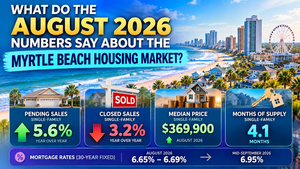
For most buyers purchasing in the Myrtle Beach area today, the $750,000 limit is the relevant threshold. According to CCAR MLS (2025 Annual Report), the Coastal Carolinas median single-family home price closed the year at $365,000. A buyer financing 80 percent of that purchase carries a loan of roughly $292,000 — comfortably within the deduction limit, meaning their mortgage interest would likely be fully deductible (assuming they itemize and meet other IRS requirements).
| Loan Origination Date | Deduction Limit (Single/Joint) | Limit if Married Filing Separately |
|---|---|---|
| Before Oct. 14, 1987 | Fully deductible (no cap) | Fully deductible (no cap) |
| Oct. 14, 1987 – Dec. 15, 2017 | $1,000,000 | $500,000 |
| After Dec. 15, 2017 | $750,000 | $375,000 |
Source: IRS Publication 936 (2025), Home Mortgage Interest Deduction. Limits apply to the combined balance of your main home and one qualifying second home. Consult a licensed tax professional for your specific situation.
What Qualifies — and What Doesn't
IRS Publication 936 (2025) is specific about what counts as deductible home mortgage interest and what falls outside the rules.
Generally qualifies:
Interest on your primary mortgage for a main home or one qualifying second home
Interest on points paid to obtain your mortgage — in some cases deductible in full in the year paid, in others spread over the loan's life depending on IRS rules
Late payment charges on your mortgage, if not charged for a specific service
Does not qualify:
Principal repayment — you're paying down debt, not interest
Homeowner's insurance premiums
Most closing costs, with limited exceptions for qualifying points
Mortgage insurance premiums — this deduction has expired. IRS Publication 936 (2025) explicitly states: "The itemized deduction for mortgage insurance premiums has expired. You can no longer claim the deduction."
A common question about home equity loans: According to IRS Publication 936 (2025), interest on a home equity loan or line of credit is deductible only if the borrowed funds were used to buy, build, or substantially improve the home securing the loan. If the funds were used for other purposes — such as consolidating debt or personal expenses — the interest does not qualify. This is one of the most frequently misunderstood aspects of the deduction.
Second home on the Grand Strand? IRS Publication 936 (2025) confirms that a second home qualifies under the deduction as long as you don't rent it out, or if you do rent it, you must personally use it for more than 14 days or more than 10 percent of the days it is rented at fair market rate — whichever is longer. This is a meaningful consideration given the volume of second-home and vacation property purchases along the Coastal Carolinas coast.
The Bigger Financial Picture for Myrtle Beach Homeowners
The mortgage interest deduction is one piece of a larger financial case for homeownership. According to the NAR 2025 Profile of Home Buyers and Sellers, 79 percent of recent buyers view a home purchase as a good financial investment, and 35 percent consider it better than owning stocks.
In the Grand Strand market, that confidence is grounded in real data. According to CCAR MLS (Monthly Indicators, February 2026), pending single-family sales in the region rose 2.2 percent year over year, and the Housing Affordability Index improved 8.6 percent for single-family homes compared to the prior February. Buyers are still active in this market, and for those financing their purchase, understanding the full annual cost — including how taxes interact with their mortgage — is part of making an informed decision.
For homeowners who purchased near the Coastal Carolinas median of $365,000 and financed most of their purchase at current rates, mortgage interest alone in early loan years may push their itemizable deductions well above the standard deduction threshold. That makes this a conversation worth having with a CPA — not just at tax time, but before closing.
If you're working through the full financial picture of buying or building a home in the Myrtle Beach area — from evaluating loan structures to understanding what ownership costs look like year to year — the team at Carolina Crafted Homes is here to help you think it through. Get in touch to start the conversation.
FAQ SECTION
Q1: Can I deduct all of the mortgage interest I paid last year? It depends on three things: whether you itemize deductions, when your loan originated, and your total mortgage balance. According to IRS Publication 936 (2025), you can generally deduct interest on mortgage debt up to $750,000 (for loans originated after December 15, 2017) on a primary residence and one qualifying second home. You must file Schedule A and itemize rather than take the standard deduction. Your lender sends Form 1098 by January 31 showing total interest paid. Consult a licensed tax professional to confirm what applies to your situation.
Q2: Does the mortgage interest deduction apply to new construction homes in Myrtle Beach? Yes — IRS Publication 936 (2025) confirms that a home under construction can be treated as a qualified home for up to 24 months, as long as it becomes your qualified home when ready for occupancy. So interest on a construction loan or mortgage taken out during the build period may qualify. The same general deduction rules apply to newly built homes as to previously owned ones, including the debt limit thresholds based on origination date.
Q3: I have a second home on the Grand Strand. Is that interest deductible? Potentially, yes. According to IRS Publication 936 (2025), interest on a qualifying second home can be deductible, subject to the same $750,000 combined debt limit that applies to your primary and second home together. If you rent the property out, you must also use it personally for more than 14 days or more than 10 percent of the days it's rented at fair market rate — whichever is longer. If those thresholds aren't met, it may be treated as rental property, not a second home, and different rules apply. Consult a licensed tax professional.
Q4: Is home equity loan interest still deductible? Only in specific circumstances. IRS Publication 936 (2025) states that home equity loan and HELOC interest is deductible only if the funds were used to buy, build, or substantially improve the home securing the loan. If you used the equity for anything else — debt payoff, personal expenses, a vehicle — the interest does not qualify under current rules. This became a stricter standard after 2017 tax law changes and remains in effect.
Q5: Can I still deduct mortgage insurance premiums? No. IRS Publication 936 (2025) explicitly states that the itemized deduction for mortgage insurance premiums has expired and can no longer be claimed. This is one of the most common misconceptions among homeowners who purchased in recent years when PMI was routine. If you've been including this deduction, review your prior returns with a licensed tax professional.
Q6: How do I know if itemizing makes more sense than the standard deduction? The 2025 standard deduction is $14,600 for single filers and $29,200 for married filing jointly. If your total deductible expenses — including mortgage interest, state and local taxes (capped at $10,000), and charitable contributions — exceed those thresholds, itemizing likely benefits you. For buyers near the Coastal Carolinas median price of $365,000 (CCAR MLS, 2025) who financed the majority of their purchase at current rates, mortgage interest alone in the early loan years may be enough to make itemizing worthwhile. A CPA can run the numbers for your specific situation.
Sources
IRS Publication 936 — Home Mortgage Interest Deduction (2025): https://www.irs.gov/publications/p936
National Association of REALTORS® — 2025 Profile of Home Buyers and Sellers: https://www.nar.realtor/
Coastal Carolinas Association of REALTORS® — 2025 Annual Report on the Coastal Carolinas Housing Market: https://www.ccarsc.org/pages/marketstats/
Coastal Carolinas Association of REALTORS® — Monthly Indicators, February 2026: https://www.ccarsc.org/pages/marketstats/
Avoid Capital Gains Tax on a South Carolina Home Sale — Carolina Crafted Homes
Closing Costs Associated with Selling Your Home — Carolina Crafted Homes