TL;DR
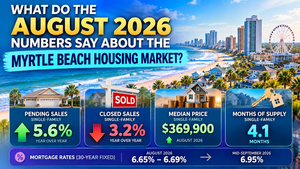
We’re seeing a market that is still being shaped by in-migration, but it is no longer the frenzied, one-directional market of the early post-pandemic years. In Coastal Carolinas, inventory has improved, single-family months of supply sat at 4.0 in February 2026, and the rolling 12-month all-property median sales price eased to $326,610, which points to a more balanced market than the peak years.
At the same time, the growth story is real. The Myrtle Beach-Conway-North Myrtle Beach house price index reached 379.48 in Q4 2025, Horry County’s house price index reached 269.58 in 2025, and local market data shows activity spread across Myrtle Beach, Carolina Forest, Conway, North Myrtle Beach, and Socastee.
South Carolina Growth and Myrtle Beach in 2026
What We Mean
We’re talking about the real effects of South Carolina’s growth, not just the headline itself. When more people keep choosing the Grand Strand, that demand shows up in home prices, competition, inventory, road usage, school planning, and the way new retail and services expand across the region.
The key point is that Myrtle Beach is now part of a broader growth system. We see activity across Horry County, from Myrtle Beach and Carolina Forest to Conway, North Myrtle Beach, and Socastee, which means the region is absorbing demand in several different ways instead of in one single corridor.
The Housing Impact
Growth always hits housing first, and that is exactly what we’re seeing here. The Coastal Carolinas annual report shows 2025 single-family closed sales rose 3.6% to 11,196, while the single-family median sales price reached $365,000. That tells us demand is still strong enough to support pricing, even as the market becomes more measured.
We also see that the market is not behaving like a runaway seller’s market anymore. In February 2026, the Coastal Carolinas report showed single-family months of supply at 4.0 and condo months of supply at 7.6, while days on market increased year over year for both property types. That means buyers have more room to compare homes than they did during the tightest inventory years.
Local market snapshot
| Metric | Reading |
|---|---|
| Coastal Carolinas all-property median price | $326,610 (down 1.0% year over year) |
| Coastal Carolinas single-family median price | $364,900 (up 1.4% year over year) |
| Coastal Carolinas single-family months supply | 4.0 |
| Coastal Carolinas condo months supply | 7.6 |
| Horry County 2025 closed sales | 16,796 |
| Myrtle Beach house price index | 379.48 (Q4 2025) |
Why Myrtle Beach Feels Different
We think one of the biggest changes is that Myrtle Beach is no longer viewed only through a vacation or second-home lens. The transcript’s core point is that the market has broadened, and the data supports that shift. Buyers are looking at Myrtle Beach, Carolina Forest, Conway, and North Myrtle Beach as full-time living markets, each with its own pricing and inventory profile.
That matters because the submarkets do not move the same way. Through February 2026, Carolina Forest’s single-family median price was $450,000 year to date, Conway was $309,995, Myrtle Beach was $516,000, North Myrtle Beach was $527,488, and Socastee was $370,000. So when people talk about “the Myrtle Beach market,” we really need to ask which part of the market they mean.
The Pressure Points
Growth brings benefits, but it also creates stress. We’re seeing the pressure show up in roads, school capacity, utilities, drainage, power, and healthcare planning, especially in fast-growing parts of Horry County. That is not a side issue — it is part of the actual housing conversation because people buying here have to live with the day-to-day results.
The county’s long-term planning documents have already acknowledged that growth requires more housing units and infrastructure planning, and the transcript reflects that lived reality on the ground. In other words, growth is not just “more people.” It is also more demand on systems that were built for a smaller market.
What Buyers Should Watch
We think the most useful way to think about Myrtle Beach in 2026 is this: the market is more balanced, but the local differences matter more than ever. A buyer looking at Conway, Carolina Forest, or Myrtle Beach proper may see very different inventory levels, price points, and competition levels.
Nationally, the backdrop is also a little more favorable than it was a year ago. NAR said affordability improved into early 2026, and its January 2026 snapshot noted that affordability was at its highest level since March 2022, even though transaction activity still lagged pre-pandemic norms. That lines up with what we’re seeing locally: better conditions than the tightest years, but not enough to make the market simple.
Our Take
We think the best takeaway is that Myrtle Beach is still growing because people want to be here, but that growth is changing the market in practical ways. Prices, infrastructure needs, traffic patterns, and inventory choices all shift when a region keeps attracting new residents.
For buyers, that means opportunity is still here, but the smartest move is to study the specific submarket instead of relying on broad assumptions. For anyone considering the Grand Strand, the real question is not whether growth is happening. The real question is how that growth affects the exact area, price point, and lifestyle you’re evaluating.
Carolina Crafted Homes stays current on Myrtle Beach market trends and can answer questions about South Carolina growth and how it affects buying in the Grand Strand. Reach out anytime for guidance—no pressure, just straightforward expertise.
FAQ
Is Myrtle Beach still growing in 2026?
Yes, and the growth is still one of the main forces shaping the local market. The region continues to see strong activity across multiple submarkets, and Horry County posted 16,796 closed sales in 2025, which shows how broad the demand base remains.
Is the Myrtle Beach housing market still competitive?
Yes, but it is more balanced than during the peak frenzy years. In February 2026, Coastal Carolinas single-family months of supply was 4.0 and condos were 7.6, which gives buyers more breathing room than before.
Are prices still rising in Myrtle Beach?
Not everywhere. The Myrtle Beach market is mixed by submarket, with some areas showing gains and others easing year to date. The broader Coastal Carolinas median price also softened slightly year over year to $326,610 in the latest rolling 12-month report.
What problems does growth create for the Grand Strand?
The biggest ones are infrastructure-related: roads, schools, utilities, drainage, and healthcare capacity. Those pressures matter because they affect how livable the market feels once people move in.
Should buyers still consider Myrtle Beach?
Yes, especially if they understand the differences between submarkets. Myrtle Beach, Carolina Forest, Conway, and North Myrtle Beach each have their own price points and demand patterns, so local context matters more than ever.