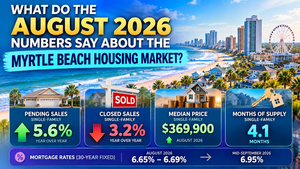
If you’ve been watching the Myrtle Beach market and thinking, “Okay… so when does this finally feel normal again?”—you’re not alone. Coastal housing doesn’t usually pivot all at once. In 2026, some parts of the market are likely to loosen quickly (think: buyer options and negotiation), while other parts will stubbornly lag (think: truly affordable monthly payments and new construction timelines). The trick is knowing which signals to trust first—especially here on the Grand Strand, where second-home demand, insurance costs, and seasonal rhythms can shift the “rules” faster than inland markets.
Below is a practical, Myrtle Beach–local forecast: what tends to move first, what takes longer, and how to plan if you’re buying, selling, or doing the “should we just stay put?” debate.
What Changes First in 2026: The Fast Movers
1) Buyer leverage shows up before prices “drop”
When the market turns, the earliest change isn’t usually a big price correction—it’s more negotiating power. In real life, that looks like:
Homes sitting longer before going under contract
More price adjustments (especially if a listing misses the mark early)
Sellers being open to concessions (closing costs, rate buydowns, repairs)
Nationally, NAR’s 2026 outlook points to a more active market with improving conditions, including a meaningful bump in existing-home sales. (National Association of REALTORS®)
That kind of “recovery” often comes with a transitional phase where well-priced homes move and everything else gets negotiated.
Local Myrtle Beach tip: In areas like Carolina Forest and The Market Common, buyers tend to respond quickly when homes feel “turnkey” and correctly priced. The listings that lag are often the ones that feel dated, overpriced, or unclear on condition/maintenance—especially if HOA rules or insurance considerations are fuzzy.
2) Mortgage rates: modest shifts matter more than people expect
You don’t need rates to fall dramatically for the market to loosen. Even a modest improvement can bring sidelined buyers back.
NAR has projected mortgage rates may decline modestly and average around 6% in 2026 (not a cliff-dive—more like a slow tide going out). (National Association of REALTORS®)
That matters because monthly payment math is sensitive: a small rate move can change buying power enough to turn “maybe later” into “let’s go see it this weekend.”
Coastal reality check: For Myrtle Beach buyers, the payment isn’t just principal + interest. It can include insurance (especially coastal), HOA dues, and sometimes flood considerations. So even if rates ease, affordability may still feel tight until the rest of the monthly-cost stack stabilizes.
3) Inventory improves in pockets before it improves everywhere
NAR research has also pointed to improving buyer opportunities tied to shifting affordability and inventory dynamics going into 2026. (National Association of REALTORS®)
In Myrtle Beach, inventory growth often appears first in:
Move-up neighborhoods (owners listing to reposition)
Homes that were “almost” rentals (owners deciding to sell)
Communities with heavier new-build competition nearby
But inventory may stay constrained in segments like:
True entry-level single-family homes in convenient locations
Well-maintained properties close to major corridors and schools
Certain condo products where financing rules/HOA strength matter
What Lags Behind: The Slow, Sticky Parts of the Market
1) Monthly affordability doesn’t snap back fast
Even if rates soften, affordability is slow to recover because it’s not a single lever. The “lag” comes from:
Insurance costs and underwriting tightening in coastal zones
HOA budgets and special assessments in some condo communities
Higher replacement-cost realities after years of inflation in materials/labor
This doesn’t mean buyers can’t win in 2026. It means the win often comes from strategy (concessions, terms, inspection clarity) rather than expecting the whole market to get cheap overnight.
2) New construction timelines and pricing can stay stubborn
Builders adjust slowly. Even if demand cools, they may hold pricing steady and shift incentives instead. In the Myrtle Beach area, incentives might look like:
Closing cost credits
Rate buydown contributions
Upgrade packages instead of price cuts
For buyers, incentives can be great—but only if you understand the full monthly cost and how long a payment benefit lasts.
3) Seller expectations take time to “recalibrate”
This is the most human lag of all.
Sellers remember their neighbor’s 2022 number. Buyers are shopping 2026 payments. That gap creates longer negotiations—especially on homes that need updates or have unclear carrying costs.
A good 2026 listing plan isn’t just “pick a price.” It’s:
Price + condition + marketing + clarity on costs (HOA/insurance context)
A realistic plan for the first 14 days on market
A negotiation posture that keeps your net strong without chasing the market down
FHA in 2026: Key Guardrails for Coastal Buyers (and Sellers)
FHA is a major on-ramp for first-time and moderate-income buyers—so it matters in Myrtle Beach, Conway, and much of Horry County.
FHA basics to keep accurate (and compliant)
FHA down payments can be as low as 3.5% for borrowers who meet credit requirements (commonly referenced at 580+ for the 3.5% minimum, with higher down payment requirements for lower scores). (HUD)
FHA has property and appraisal standards lenders follow via HUD’s Single Family Housing Policy Handbook (4000.1). (HUD)
Coastal implication: Condition matters. Peeling paint, roof life concerns, moisture intrusion, unsafe handrails—those can become negotiation points because they can become lender conditions. Planning ahead (or pre-inspecting) often prevents “surprise renegotiations” later.
FHA loan limits in 2026: Myrtle Beach/Horry County
HUD issued official 2026 nationwide forward mortgage loan limits via Mortgagee Letter 2025-23. (HUD)
For Horry County (Myrtle Beach-Conway-North Myrtle Beach), published FHA limit tables show a one-unit limit of $541,287 for 2026 (with higher limits for 2–4 units). (FHA)
HUD also notes the 2026 nationwide floor/ceiling for one-unit FHA forward mortgages is $541,287 to $1,249,125. (HUD)
Practical takeaway: In many Myrtle Beach neighborhoods, that one-unit FHA ceiling is enough to cover a wide range of primary-residence options—especially slightly inland (Carolina Forest/Conway side) where price-per-foot can be more forgiving than direct oceanfront.
FHA servicing/loss mitigation updates affecting 2026
HUD also issued guidance updating servicing, loss mitigation, and claims, with changes effective February 2, 2026, and an extension of certain COVID-19 recovery options through February 1, 2026. (HUD)
If you’re a homeowner who’s struggled with payments, the “what help exists and when” timeline matters—and it’s worth talking with your servicer or a HUD-approved housing counselor early.
(Guardrail note: This is general information, not legal or financial advice. Loan eligibility, pricing, and underwriting depend on lender guidelines and your scenario.)
Grand Strand Micro-Trends to Watch in 2026
Carolina Forest: “Convenience value” stays strong
Carolina Forest tends to hold demand because it blends schools, access, and newer housing stock. In 2026, watch for:
More resale competition from nearby new construction offerings
Buyers negotiating more on homes that aren’t updated
Strong performance for homes that photograph well and feel move-in ready
The Market Common + closer-to-coast lifestyle hubs: scarcity supports pricing
Lifestyle-forward areas often lag on “price softening” because buyers aren’t purely buying a house—they’re buying proximity and walkability. Negotiation may show up more in terms than in headline price.
Condos: financing + HOA clarity will separate winners and laggards
Condo markets can move quickly, but 2026 buyers are going to ask more questions:
HOA financial health and reserves
Insurance situation
Any special assessments
Owner-occupancy vs. rental mix (which can affect some financing paths)
How to Use This Forecast If You’re Buying in 2026
Start with monthly cost reality, not just purchase price.
Get clear on financing paths early (conventional, FHA, VA, etc.). FHA can be powerful, but condition and documentation matter. (HUD)
Build negotiation into your plan. In a more balanced market, “ask for it” becomes a normal part of winning a deal.
How to Use This Forecast If You’re Selling in 2026
Win the first impression battle. Photos + condition + pricing create momentum.
Expect smarter buyers. They’ll compare HOA costs, insurance realities, and inspection outcomes.
Pre-plan concessions. A targeted credit can protect your net more than a late price drop.
If you’re planning a move anywhere along the Grand Strand—Carolina Forest, Market Common, Conway, North Myrtle Beach, or somewhere in between—Carolina Crafted Homes can help you map out a 2026 game plan with real numbers and neighborhood context. Schedule a consultation and we’ll talk through timing, financing options (including FHA guardrails), and what buyers are actually reacting to right now.
FAQs
1) Will Myrtle Beach home prices drop in 2026?
Most “change” in 2026 is more likely to show up as negotiation—price reductions on overpriced listings, seller credits, and better terms—before a broad-based price slide. National forecasts point toward increased existing-home sales and modestly improved rates, which can support demand. In Myrtle Beach, pricing often stays firmer in lifestyle hubs (Market Common, close-to-coast pockets) and becomes more negotiable where inventory grows.
2) What mortgage rate trends are expected for 2026?
NAR has projected mortgage rates could decline modestly, averaging around 6% in 2026. (National Association of REALTORS®) Even small rate moves can impact buying power—especially for first-time buyers. In coastal South Carolina, remember your full monthly payment includes more than principal and interest (insurance/HOA can be significant), so a rate dip helps—but may not “fix” affordability by itself.
3) What are the FHA loan limits for Myrtle Beach in 2026?
For Horry County (Myrtle Beach–Conway–North Myrtle Beach), published 2026 FHA limits show a one-unit limit of $541,287, with higher limits for 2–4 unit properties. (FHA) HUD’s nationwide 2026 floor/ceiling for one-unit FHA forward mortgages is $541,287 to $1,249,125. (HUD) Always confirm limits on HUD’s official lookup tool or with your lender for your exact property type.
4) What are the basic FHA requirements buyers should know in 2026?
FHA can allow down payments as low as 3.5% for qualified borrowers, commonly referenced with credit guidelines around 580+ for the minimum down payment option. (HUD) FHA loans also follow HUD’s Single Family Housing Policy Handbook (4000.1), which includes property/appraisal standards that can trigger repairs or conditions. (HUD) Talk with a lender early so you know what to expect.
5) Are there any South Carolina real estate licensing updates that matter in 2026?
South Carolina’s LLR published a summary of 2025 changes to the Real Estate Practice Act (HB 3947), including continuing education reciprocity rules for some nonresident licensees and an option for certain long-tenured licensees age 65+ to renew an expired license under specific conditions. For consumers, the key takeaway is to work with properly licensed professionals and verify status through official state resources when needed.