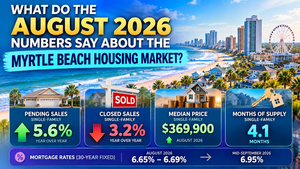
Choosing whether to buy an existing home or build new in Myrtle Beach in 2026 comes down to trade-offs between cost, timing, customization, and risk. Current data shows a stabilizing but still price-sensitive Grand Strand market, which makes the “buy vs. build” question more about fit than about chasing fast appreciation.
2026 Myrtle Beach market snapshot
Across the Coastal Carolinas, single-family closed sales rose 3.6% in 2025, while condo sales slipped 3.1%, signaling steady demand for detached homes but some softness in attached product. The median single-family sales price climbed to 365,000, up 1.4% year-over-year, while condo medians declined 3.7% to 238,825.
Inventory has also shifted. Single-family homes ended 2025 with 3,416 active listings, essentially flat from 2024, but condo inventory rose 5.5% to 2,881 units, giving buyers more options in attached housing and more negotiating leverage. Months’ supply stands around 3.7 months for single-family and 7.0 months for condos, a sign that single-family remains tighter and more competitive than the condo segment.
Nationally, the median existing-home price reached about 409,200 in late 2025, up 1.2% year-over-year, while mortgage rates averaged in the high-6% range during the NAR survey period. Locally, the Housing Affordability Index for single-family homes in the Coastal Carolinas improved modestly to 77 in 2025, suggesting buyers gain a bit more breathing room but still face meaningful affordability pressure.
Buy vs. build: how the numbers compare in 2026
Most Grand Strand buyers are still purchasing existing homes rather than building new, but new construction carries an important share of the market in specific subareas. Nationally, only about 12–16% of recent buyers reported purchasing a new home, with the balance choosing previously owned properties. Within Horry County, new construction reached roughly one-third of all closed sales in 2025, with areas like Loris/Longs and Socastee seeing 40–64% of activity tied to new builds.
On the price side, the region-wide median for all property types is 328,000, but single-family homes average higher at 365,000, and some popular Myrtle Beach-area submarkets run above that. For example, 2025 median prices came in around 398,944 in Carolina Forest, 390,000 in Garden City/Murrells Inlet, and 407,950 in North Myrtle Beach, while central Myrtle Beach logged a lower median of 260,000 due in part to its heavy condo mix.
A typical existing home purchased nationally is about 1,900 square feet, with three bedrooms and two baths, and was originally built around 1994. New homes that buyers chose skewed a bit larger—around 2,000 square feet—and often sit in amenity-rich communities, which is consistent with the Grand Strand’s pattern of master-planned neighborhoods west of the Intracoastal. When you translate that into cost per square foot locally, many buyers find they can secure more total square footage in an existing home at the same budget, though with less personalization.
Why some buyers should lean toward buying in Myrtle Beach
Buying an existing home tends to work best for buyers who prioritize location options, faster move-in, and budget certainty. The Coastal Carolinas data shows a median of 126 days on market overall in 2025, with closed sales at a median of 99–97% of list price, so the path from offer to closing is relatively predictable compared with a construction timeline.
More inventory is appearing in key price brackets. Closed sales in the 150,000-and-below range jumped 22% in 2025, and the 150,001–250,000 bracket also saw modest growth, giving more choices to value-focused buyers in Horry County towns like Conway and Socastee. At the same time, days on market lengthened into the 120–130 day range in many price bands, another hint that buyers can negotiate more and take the time to find the right fit instead of rushing into construction.
National survey data highlights why most buyers still go this route. About 88% of recent buyers purchased through an agent and 88% chose previously-owned homes, citing “better overall value” and “better price” as leading reasons. Buyers also report that finding the right property is the hardest step—over half say this is their top challenge—so having a larger pool of existing homes across the Grand Strand can make the search process smoother.
Why some buyers should lean toward building in 2026
Despite higher upfront costs, building can be compelling for buyers who place a premium on new systems, customization, and energy efficiency. Nationally, 43% of buyers who chose new construction did so to avoid renovations and older systems, and 22% wanted the ability to customize design features from day one. In coastal climates like Myrtle Beach, newer roofs, windows, and mechanical systems can be especially attractive for long-term maintenance and insurance considerations.
In the Coastal Carolinas MLS, single-family homes remain the strongest-performing property type, and new-construction-heavy submarkets like Loris/Longs, Carolina Forest, and Socastee show robust shares of new builds—up to 64% of all closed sales in Loris/Longs. This gives build-minded buyers multiple options, from production communities with established floor plans to more flexible neighborhoods where a semi-custom or custom design may fit.
One overlooked factor is how long buyers expect to stay. NAR data shows typical buyers plan to remain in their homes for a median of 15 years, and 28% say they are “never moving.” For someone with that longer horizon, spreading the premium of a new build over more years can make the higher initial cost feel more reasonable, particularly if the home is designed around single-level living or specific accessibility needs that are harder to find in older resale inventory.
Financing, cash, and affordability: how they influence buy vs. build
Financing conditions in 2025–2026 shape whether buying or building feels realistic. Nationally, 74% of buyers financed their purchase, with first-time buyers typically borrowing about 90% of the price and repeat buyers around 77%. The median down payment rose to 19% overall—10% for first-time buyers and 23% for repeat buyers—which is the highest level for first-time buyers since the late 1980s.
In the Coastal Carolinas, the Housing Affordability Index for single-family homes held around 75–77 in 2025, and for condos it improved to about 118, confirming that attached homes remain more affordable than detached homes at current rates. Inventory for condos has grown faster—up more than 55% from 2023 to 2025—which is why the condo months’ supply sits at roughly 7.0, signaling a more buyer-friendly environment for attached product than for new single-family builds.
Cash also plays a role. About 26% of recent buyers nationwide paid all cash, a series high, and repeat buyers often bring equity from prior homes to the table. For these buyers, building can be less constrained by appraisals and construction-loan requirements, but for buyers with smaller down payments, purchasing an existing home that fits traditional mortgage guidelines may be the more practical route.
Practical decision table: buy vs. build in the Grand Strand
Here’s a concise way to think about which option might align with your priorities in Myrtle Beach and nearby submarkets:
| Priority or factor | Buying existing home – how it fits | Building new – how it fits |
|---|---|---|
| Upfront cost sensitivity | Often lower price per square foot; more options in the $150,000–$350,000 brackets where most 2025 sales occurred. | Typically higher base price plus lot and upgrades, especially in popular submarkets with 2025 medians near or above $400,000. |
| Timeline and certainty | Typical 30–60 day escrow once under contract; median days on market settled around the low-120s, allowing time to shop. | Build timelines can stretch many months and carry material or labor delays, which adds uncertainty beyond the resale closing window. |
| Customization and layouts | Limited to what is available; many existing homes are ~1,900 sq. ft., 3-bed/2-bath layouts built in the 1990s. | Floor plan, finishes, and energy features can be tailored from the start; buyers choosing new often prioritize this control. |
| Ongoing maintenance and systems | Older homes may need roof, HVAC, or cosmetic updates sooner; 53% of sellers report doing at least minor repairs before listing. | New systems typically reduce near-term maintenance risk; buyers cite avoiding renovation issues as their top reason for choosing new. |
| Neighborhood and amenity selection | Broad range across Horry County, from Conway to Pawleys Island, with 2025 medians from $260,000 in Myrtle Beach to $513,745 in Pawleys Island/Litchfield. | Often tied to master-planned or newer communities (e.g., Carolina Forest, Loris/Longs), where new construction accounts for 40%+ of sales. |
| Long-term stay (10–15+ years) | Works well if the home already matches your long-range needs; 35% of buyers say they may move only for life changes. | Can be ideal if you design around your projected needs for 10–15 years, which is the median expected tenure for recent buyers. |
How to decide your best path in 2026
Because the Grand Strand market is stabilizing rather than swinging sharply, the “right” answer for 2026 depends more on your personal constraints than on trying to outguess the market. The modest 1.4% annual gain in regional single-family prices and slight 0.6% overall median price dip show a market where buyers can be deliberate. At the same time, the 3.7 months’ single-family supply and roughly 97% list-to-sale ratios indicate that desirable homes—especially newer ones in strong neighborhoods—still command solid prices.
A useful exercise is to run two parallel budgets: one for an existing home in the areas you like (using current medians as a starting point for Myrtle Beach, Carolina Forest, Conway, etc.), and another for a realistic new-build scenario including land, construction, and a buffer for overruns. Layer on your financing profile using recent NAR figures for typical down payments and the local affordability indices to see which option leaves more room in your monthly budget for taxes, insurance, and coastal maintenance.
For many 2026 buyers in Myrtle Beach, a hybrid approach also makes sense: targeting “nearly new” resale homes built within the last five to ten years in new-construction-heavy submarkets. These properties can offer much of the low-maintenance appeal of a new build but with more predictable pricing and timelines tied to the resale market. Carolina Crafted Homes can help you compare those paths against current new-build opportunities across Horry and Georgetown counties, using up-to-date MLS data rather than rules of thumb.
Carolina Crafted Homes stays current on Myrtle Beach market trends and can answer questions about whether you should buy or build in Myrtle Beach in 2026. Reach out anytime for guidance—no pressure, just straightforward expertise.
FAQs
Q1. Is it cheaper to buy or build a home in Myrtle Beach in 2026?
In 2025, the median single-family sales price across the Coastal Carolinas reached 365,000, while the overall median for all property types was 328,000, reflecting relatively modest price growth. New construction typically adds a premium for land, customization, and materials, especially in submarkets where medians already sit near or above 400,000 such as Carolina Forest and North Myrtle Beach. Because of that, buyers often find it more budget-friendly to purchase an existing home—especially condos or older single-family homes—than to build from scratch at today’s construction and financing costs.
Q2. How long does it take to buy versus build in the Myrtle Beach area?
Closed sales data for 2025 show average days on market around 126 days for all properties, with single-family homes taking roughly 123 days and condos about 132 days from listing to accepted offer. Once under contract, many transactions close in another 30–60 days, giving a total window of a few months for most buyers. By contrast, new construction timelines routinely stretch longer due to permitting, site prep, and build time, and national survey data highlights that buyers choose new builds largely to avoid renovations rather than to move quickly.
Q3. Are there enough lots and new construction options in Horry County to make building realistic?
Market overviews for 2025 show that new construction already accounts for about one-third of closed sales in Horry County, with some markets like Loris/Longs reporting 64% of sales tied to new homes. Areas such as Socastee and Carolina Forest also show new-construction shares above 40%, confirming that buyers who want to build or buy new have multiple neighborhood options across the Grand Strand. At the same time, overall single-family inventory stayed roughly flat while condo inventory increased, so lot and new-build availability will still vary by price point and submarket.
Q4. How do current mortgage and affordability trends affect whether I should buy or build?
Nationally, mortgage rates during the 2024–2025 survey period averaged about 6.69%, which, combined with higher home prices, pushed many first-time buyers out of the market and increased typical down payments. In the Coastal Carolinas, the single-family Housing Affordability Index hovered around 75–77 in 2025, while condos reached about 118, illustrating that attached homes remain more affordable than detached homes at today’s rates. Because building often requires a larger budget and potentially a construction loan, buyers with tighter affordability margins may find purchasing an existing home better aligned with current lending conditions.
Q5. What are the main reasons buyers today choose new construction over resale?
According to NAR’s 2025 Profile of Home Buyers and Sellers, 43% of buyers who purchased new construction did so to avoid renovations or problems with plumbing and electrical systems. Another 22% cited the ability to choose and customize design features, and 17% pointed to amenities available in new-home communities as a major draw. In coastal markets like Myrtle Beach, these motivations combine with a desire for modern energy-efficient systems and community amenities, which many buyers see as justifying the premium over older resale properties.
Q6. How long do most buyers plan to stay in the homes they buy or build now?
NAR data shows that recent buyers expect to live in their homes for a median of 15 years, and 28% say they are effectively in a “forever home.” That long expected tenure helps explain why some buyers are willing to pay more for new construction that matches their long-term needs, even when resale options are less expensive. In a stabilizing market like the Coastal Carolinas, with modest price appreciation and improving but still constrained affordability, this longer horizon can be an important factor in the buy-versus-build calculation.