TL;DR: Inside Myrtle Beach city limits, short-term rentals are legally called "visitor accommodations" — any stay under 90 continuous days — and they're treated as a commercial use. They're permitted in only eight zoning districts. If a property sits in a standard single-family or most multi-family residential districts, nightly rental isn't allowed, and an existing rental operation can lose its protected status after 12 months of disuse.
Buyers shopping the Grand Strand for rental income often ask the zoning question last. It should be first.
The City of Myrtle Beach doesn't use the word "Airbnb" anywhere in its code. It regulates the activity under a defined term — visitor accommodation — and the definition is precise enough to settle most disputes before they start. Get the district right and the path is clear. Get it wrong and you own a house you can't legally rent the way you planned.
Buyer interest in the area remains active. According to the CCAR Showings Report (April 2026), Myrtle Beach recorded 8,000 total showings, up 7.8% year over year. Demand isn't the constraint. Zoning often is.
Can You Airbnb in Myrtle Beach? Start With the 90-Day Rule
Myrtle Beach draws a bright line at 90 days.
Under the City of Myrtle Beach Code of Ordinances (Appendix A, § 203, codified through April 2025), a visitor accommodation — expressly identified as a short-term rental — is any living unit rented, leased, subleased, or otherwise furnished to another for less than 90 continuous days. The definition also captures timesharing, fractional ownership, and tenancy-in-common arrangements.
One more clause does a lot of work: a visitor accommodation is considered a commercial use.
That reclassification is the reason the answer isn't universal. A commercial use has to be permitted in the district where the property sits. In most of the city's residential districts, it isn't.
So the practical question isn't "can you Airbnb in Myrtle Beach." It's "what district is this specific parcel in?"
Where Short-Term Rentals Are Allowed in Myrtle Beach
The city's Table of Uses (Appendix A, Article 14, § 1407) lists visitor accommodations as permitted in eight districts and available by special exception in one.
Myrtle Beach zoning districts permitting visitor accommodations (short-term rentals)
| District | District Name | Status |
|---|---|---|
| RMV | Multi-family Residential – High Density with Visitor Accommodations | Permitted |
| A | Amusement District | Permitted |
| E | Entertainment District | Permitted |
| C6 | Urban Village District | Permitted |
| HC1 | Highway Commercial District | Permitted |
| HC2 | Highway Commercial District (Mixed-use) | Permitted |
| MU-H | Mixed Use, High Density | Permitted |
| IR | Interim Redevelopment District | Special exception (§ 1503.A) |
Source: City of Myrtle Beach Code of Ordinances, Appendix A, Art. 14, § 1407 (codified through April 22, 2025).
Note what's missing. Visitor accommodations are not a permitted use in the single-family residential districts (R5, R7, R8, R10, R15), and not in most multi-family districts either — RMM, RMH, and RMH-MH are all excluded. Neither is MU-M, the medium-density mixed-use district.
RMV is the exception among residential districts, and its full name says why: Multi-family Residential District – High Density with Visitor Accommodations. The category is built into the district.
Verify the parcel's district designation and permitted uses with the City of Myrtle Beach zoning office before making an offer, and consult a licensed South Carolina real estate attorney for your specific situation.
Grandfathering Is Real — and Easier to Lose Than Buyers Expect
Some properties operate as legal nonconforming uses under Article 7 of the zoning ordinance. A use that legally existed before the current rules may continue.
But the conditions are strict, and three of them catch people out:
Abandonment ends it. Under § 705.B.2, a nonconforming use abandoned for 12 consecutive months can't be reestablished. The ordinance defines abandonment as discontinuation "whether temporarily or permanently, whether with the intent to abandon said use or not." A property held off the rental market through a renovation or a slow season can quietly cross that line.
No going back. Once a nonconforming use changes to a conforming use, § 705.B.1 bars reverting.
Owner-requested rezoning kills it immediately. Section 705.B.3.d states that visitor accommodations made nonconforming by a rezoning the owner requested must cease immediately upon the rezoning's effective date.
There is a narrow rebuild allowance: § 705.A.3 permits restoring a nonconforming building damaged by fire, flood, or similar calamity, provided a building permit is obtained within 12 months and maintained without lapsing.
If a seller says a property is grandfathered, ask for documentation of continuous use — not just a rental history printout. Verify the status in writing with the city.
The Overlay Zone That Works in the Other Direction
Most short-term rental regulation restricts nightly rentals. Myrtle Beach has one that protects them.
The Short-Term Rental Conversion (STRC) Overlay Zone (§ 1808, adopted December 2024) applies to commercial uses between Kings Highway and the Atlantic Ocean within city limits. Its stated purpose is preserving tourist accommodations along the oceanfront.
Inside the overlay, a building of more than two units that was constructed or used as a visitor accommodation may not be rented or leased for 90 continuous days or more. Stringing together successive sub-90-day leases to let one occupant stay longer is explicitly a violation.
There's a carve-out: owners legally operating with a long-term rental business license when the overlay was adopted may continue, so long as they maintain that license.
For oceanfront buyers, this cuts both ways. It supports the short-term rental character of the corridor. It also means a "we'll convert to long-term if nightly rates soften" fallback may not be available.
Licensing, Taxes, and Parking
Zoning approval isn't the last step.
Section 11-25(f) of the city code requires anyone renting one or more properties to register the business and apply for a license. Short-term and vacation rentals owe state and local accommodations tax and hospitality fees.
Parking standards also apply, since visitor accommodations are a commercial use. The ordinance requires one space per one-bedroom unit, two spaces per three-bedroom unit, and 0.5 spaces for each additional bedroom. On a tight infill lot, parking can constrain what's buildable before zoning ever does.
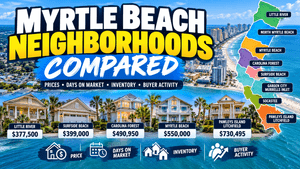
If you're weighing where to buy, our Myrtle Beach market breakdown by city covers pricing across the area. For context on entry cost, CCAR MLS (April 2026) put the Myrtle Beach townhouse/condo median at $208,500 and the single-family median at $478,000.
Zoning is the cheapest thing to check and the most expensive thing to get wrong. If you're considering building in Myrtle Beach with rental use in mind, the district designation and permitted-use question belongs in site selection — before a lot goes under contract, not during due diligence. We work through zoning classification, parking requirements, and permitted uses with clients while there's still room to choose a different parcel. If you'd like to talk through what's workable for a specific area, start the conversation with our team.
FAQ SECTION
Can you Airbnb a house in Myrtle Beach?
Only if the property sits in a zoning district where visitor accommodations are permitted. Under the City of Myrtle Beach Code of Ordinances (Appendix A, § 1407), that means RMV, A, E, C6, HC1, HC2, or MU-H, plus IR by special exception. Visitor accommodations are not permitted in the single-family residential districts (R5 through R15) or in the RMM, RMH, RMH-MH, and MU-M districts. Confirm the specific parcel's district with the city zoning office in writing before making an offer.
What counts as a short-term rental in Myrtle Beach?
The city defines a visitor accommodation as any living unit rented, leased, subleased, or furnished to another for less than 90 continuous days. That threshold is much longer than the 30-day line many buyers assume. The definition also covers timesharing, fractional ownership, and tenancy-in-common arrangements. Critically, the ordinance classifies a visitor accommodation as a commercial use, which is why it must be a permitted use in the applicable zoning district rather than allowed by default.
What is the RMV zoning district?
RMV stands for Multi-family Residential District – High Density with Visitor Accommodations. It's the one residential district in Myrtle Beach where short-term rental is a permitted use by right, and the district name reflects that directly. The other residential districts — R5, R7, R8, R10, R15, RMM, RMH, and RMH-MH — do not permit visitor accommodations. If a listing describes rental potential, the district designation is the fact worth verifying first.
Can a grandfathered short-term rental lose its status?
Yes. Under § 705.B.2, a nonconforming use abandoned for 12 consecutive months cannot be reestablished, and the ordinance defines abandonment as discontinuation whether temporary or permanent, regardless of intent. Section 705.B.1 also bars reverting once the use has changed to a conforming one. And § 705.B.3.d requires visitor accommodations made nonconforming by an owner-requested rezoning to cease immediately. Request written confirmation of continuous use, not just a rental history.
What is the STRC Overlay Zone?
The Short-Term Rental Conversion Overlay Zone (§ 1808, adopted December 2024) applies between Kings Highway and the Atlantic Ocean within city limits. It prohibits buildings of more than two units that were built or used as visitor accommodations from being rented for 90 continuous days or more, and bars using successive shorter leases to work around that. Owners holding a long-term rental business license when the overlay was adopted may continue under that license. Its purpose is preserving oceanfront tourist accommodations.
What licenses and taxes apply to a Myrtle Beach short-term rental?
Section 11-25(f) of the city code requires anyone engaged in renting one or more properties to register the business and apply for a license. Short-term and vacation rentals owe state and local accommodations tax and hospitality fees as provided by law. Parking standards also apply because visitor accommodations are a commercial use — one space per one-bedroom unit, scaling up with bedroom count. Verify current requirements directly with the city and consult a licensed tax professional.
Sources
City of Myrtle Beach, SC Code of Ordinances — Appendix A (Zoning) §§ 203, 705, 1402, 1407, 1503, 1808; and § 11-25 (Business Licenses). Codified through April 22, 2025: https://library.municode.com/sc/myrtle_beach
Coastal Carolinas Association of REALTORS® — Local Market Update & Showings Report, April 2026: https://www.ccarsc.org/pages/marketstats/