Everyone waiting for the "perfect time" to buy a home is losing money right now. Not in the dramatic way—where prices suddenly spike—but in a way that compounds silently: delayed decisions made in slower markets still cost thousands. As of January 2026, Myrtle Beach offers an unusual advantage that changes the timing equation entirely. Here's what the data actually shows.
The Myth: "I'll Wait for Better Rates or Lower Prices"
Mortgage rates in January 2026 have dropped to 5.87%–6.10%, the lowest levels seen since 2022, according to Freddie Mac and Zillow. A year ago (January 2025), rates averaged 7.04% for a 30-year mortgage. That 117-basis-point drop represents real savings. But here's the trap: buyers who waited from January 2025 hoping rates would fall further spent 12 months on the sidelines.
Consider the math. A buyer waiting a year expecting rates to drop from 7% to 5.9% could have locked in at 6.5% months ago. On a $400,000 home (near Myrtle Beach median), the difference between 6.5% and 7% is approximately $142 per month. Over 12 months, that's $1,704 in extra cost just for waiting. And the waiting buyer still didn't get rates below 6%.
The Local Advantage: Myrtle Beach's Balanced Market (Right Now)
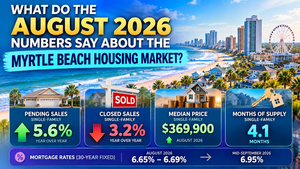
Myrtle Beach real estate has shifted decisively into buyer-friendly territory. According to latest market data, the Grand Strand shows 5.3 months of inventory for single-family homes—the definition of a balanced market. Median home prices in Horry County sit around $405,000 for single-family homes and $220,000 for condos, with median time on market at 107 days for homes and 118 days for condos.
The list-to-sale ratio across Horry County recently dipped to 96%, meaning homes are selling below asking. That leverage extends across neighborhoods from Carolina Forest (averaging $648,000) to waterfront condos ($296,000 average). This balance exists because of structural shifts, not temporary fluctuation.
The Psychology Problem: Why Waiting Actually Increases Risk
NAR's 2025 Profile of Home Buyers and Sellers reveals something crucial: 45% of buyers said "the timing was just right, and they were ready to purchase." The second most common reason? "I did not have much choice; I had to purchase when I did" (20%). Only 4% cited waiting because they "wished they had waited."
More telling: homebuyer regret has declined sharply. According to Realtor.com's 2025 Consumer Attitudes & Usage Study, 37% of buyers reported zero regrets about their purchase—up from 31% in 2023. The share believing they "paid too much" dropped from 15% (2023) to just 8% (2025). Slower markets with more time to decide actually reduce regret.
The waiting buyer creates psychological risk. Markets change—not just prices, but inventory, rates, and personal circumstances. Waiting a year compounds uncertainty about three unknowns: where rates will be, where prices will be, and whether your life situation will remain stable for a home purchase.
The Rate-Buydown Counterargument (Why It Fails)
Some buyers believe builders will offer better rate buydowns if they wait. Myrtle Beach builders occasionally do—but data shows those concessions shrink as rates drop. When rates were 7%+, buydowns to 6.5% felt valuable. At 5.87%, buydowns to 5.5% become rare. The advantage erodes exactly when you're waiting for it.
The Actual Cost of Perfect Timing
Let's quantify what "waiting for perfect conditions" costs in Myrtle Beach:
Lost equity: A $405,000 home appreciating at 1–3% annually (current NAR forecast for 2026) gains $4,050–$12,150 in equity per year. Waiting = lost equity.
Rent inflation: Rents in South Carolina continue rising. Staying rented while waiting costs $1,200–$1,600/month (Myrtle Beach market average). Over 12 months: $14,400–$19,200 in rent with no equity.
Rate-lock regret: If rates rise from 5.87% to 6.5% while waiting, that $142/month difference becomes permanent for 30 years. On a $400,000 loan, that's $51,120 in additional interest.
Opportunity cost: The buyer who purchased at 7% (January 2025) and locked in a $405,000 home is now building equity in an asset appreciating at 2–3% annually. The waiting buyer hasn't built any equity yet.
Why 2026 Is Structurally Different from 2022-2024
The housing market of 2022–2024 was characterized by extreme scarcity and runaway appreciation. Myrtle Beach saw single-family homes climb significantly during the pandemic boom. Correction has arrived. The Myrtle Beach–Conway–North Myrtle Beach metro's house price index shows stabilization, with only marginal month-to-month movement in recent quarters. Inventory has normalized. Markets no longer flash "hot" signals. The NAR forecasts 1–3% annual appreciation for 2026, not double digits.
This is why waiting in a balanced market is different from waiting in a boom. In 2024, waiting made sense for some buyers hoping for correction. In January 2026, the correction is already priced in.
Who the "Perfect Timing" Myth Hurts Most
First-time buyers feel this pressure acutely. NAR data shows first-time buyers have a median age of 40 (up from 38 last year), and many cite "high rent and student loans" as barriers to saving. The older first-time buyer has less time to recover from a wrong decision—so "waiting to be certain" is actually riskier.
Similarly, buyers relocating to Myrtle Beach from higher-cost markets (New York, Massachusetts, California) are often on fixed timelines. An employer relocation date doesn't wait for "perfect rates." A lease end-date arrives whether the market is perfect or not.
What the Data Actually Says About Timing
Of buyers surveyed in 2025:
92% felt satisfied with their buying process (NAR)
79% view homeownership as a good financial investment
Only 8% regret paying "too much" (down from 15% in 2023)
These buyers weren't waiting for perfection. They were making informed decisions in imperfect conditions.
The Only Real Timing Risk
There is one legitimate timing concern: rising rates after purchase. If rates spike from 5.87% to 8%, your fixed-rate lock-in becomes golden. But that's not a reason to wait—it's a reason to move now while rates are favorable. The waiting buyer faces both rate risk (upside) and lost equity (downside).
For Myrtle Beach Specifically
Single-family pending sales are up 24% year-over-year. Condo pending sales show 21% YoY growth. This isn't a "dead market" requiring patience. It's active enough that inventory can tighten quickly, especially as spring approaches and new listings slow.
The median first-time buyer down payment is now 10%—the highest since 1989—suggesting qualified buyers are actively purchasing. Homes with good fundamentals in desirable Horry County neighborhoods (Carolina Forest, North Myrtle Beach, Murrells Inlet) are not sitting long.
What "Perfect Timing" Actually Means
Perfect timing isn't about rates and prices aligning magically. It's about readiness: financial stability, clear motivation, and alignment with life needs. According to NAR, that's why 45% of recent buyers simply said "the time was right"—because their circumstances matched the market moment, not the other way around.
The Myrtle Beach market of January 2026 is stable enough for confident decisions and liquid enough to move quickly. The "perfect time" is now—not because rates will never drop or prices will never adjust, but because waiting guarantees lost opportunity and regret has already become someone else's story.
Carolina Crafted Homes stays current on Myrtle Beach market timing and decision-making. Reach out anytime for straightforward guidance on whether now makes sense for your situation—no pressure, just expertise grounded in current data.
FAQs
Q1: If mortgage rates drop further after I buy, won't I regret not waiting?
A: That's possible—but equally possible is rates rising. The Jan. 2026 rate of 5.87% is already 117 basis points lower than Jan. 2025. Buyers who waited from last year hoping for further drops still didn't get the rates they wanted. Locking in favorable rates now removes upside risk. The real question: can you afford the payment at today's rate? If yes, waiting for a better rate is speculation, not strategy.
Q2: Aren't Myrtle Beach home prices still too high compared to 2021?
A: Yes, but they're not rising anymore. The market shows 1–3% annual appreciation expected in 2026, not the 12%+ seen 2021–2022. Price growth has normalized. Single-family homes selling at 96% of asking price (down from 100%+) in a balanced market suggest prices have stabilized. Waiting for further correction adds cost with no guarantee correction will come.
Q3: Will inventory increase more, bringing prices down further?
A: Unlikely in the short term. Myrtle Beach shows 5.3 months of inventory—balanced, not oversupplied. Horry County inventory is tight enough that homes move in 107 days on average. New construction is steady. Supply isn't collapsing, but it's stable enough to support current pricing. Waiting for "excess inventory" may mean waiting indefinitely.
Q4: What if my life situation changes and I can't buy next year?
A: This is the hidden cost. Job relocation, family changes, lease expirations—life timing matters more than market timing. If your circumstances align now, waiting adds personal risk unrelated to real estate conditions. NAR data shows only 4% of buyers regret the timing of their purchase; most regret happens when they rush the decision unprepared.
Q5: How much does waiting a year actually cost financially?
A: On a $405,000 home with 2% annual appreciation, you lose $8,100 in equity annually. Add rent costs of $1,200–$1,600 per month, and you're spending $14,400–$19,200 yearly. If rates rise from 5.87% to 6.5% while waiting, the rate-lock regret adds $51,120 in lifetime interest. The cost of waiting usually exceeds the cost of buying "imperfectly."
Q6: Is now a good time to buy in Myrtle Beach compared to other markets?
A: Relative to national conditions, yes. Myrtle Beach rates of 5.87%–6.10% are near historic lows, and inventory is balanced. Compared to high-inventory markets like Austin or Atlanta, it's less of a buyer's market. But compared to tight Northeast markets, it's favorable. For someone relocating to the Grand Strand specifically, now offers both rate advantage and negotiating room.