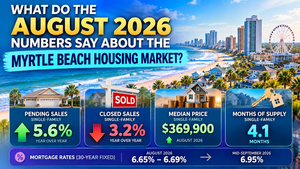
The real estate market of 2026 has made something crystal clear: market conditions matter far less than pricing strategy. While national data shows existing-home sales climbing 1.7% annually and mortgage rates hovering around 6.3%, the story that's truly reshaping outcomes in Myrtle Beach and beyond is simpler—sellers who price strategically dominate those who don't. In the Horry County market, where home values have softened 3.7% year-over-year and days-on-market metrics vary by segment, correct pricing has emerged as the single most powerful tool in a seller's toolkit. This isn't about waiting for better conditions. It's about executing smarter strategy right now.
The Data Behind Pricing Dominance
Recent market data from the 2025 NAR Profile of Home Buyers and Sellers underscores a critical reality: pricing directly impacts everything downstream. Homes priced correctly move faster, attract more qualified buyers, and ultimately close closer to—or above—asking price. According to NAR research, recent home buyers typically purchased their homes for a median of 99% of the asking price, while 31% of all buyers paid exactly 100% of asking, and 17% paid more than asking price.
But timing matters tremendously within that dynamic. Homes on the market for just 1-2 weeks consistently achieved 100% of asking price, while those lingering 17+ weeks saw median sales prices drop to just 90% of asking. That spread—10 percentage points—translates to tens of thousands of dollars on a typical Myrtle Beach home.
In Horry County specifically, inventory stood at 7,483 active listings as of December 2025, while median days on market have shifted noticeably across segments. Properties priced aggressively to market conditions are closing in 60-70 days on average, while overpriced inventory is hitting 130+ days on market. The market has become unforgiving of pricing mistakes.
Why Sellers Continue to Struggle with Pricing
The NAR report reveals the true challenge: 73% of sellers don't offer any incentives, placing the entire burden of attraction on price and presentation. Yet, 51% of sellers still reduce their asking price an average of 3-4 times during the listing period—a clear indicator they started too high.
This is the pricing strategy failure in slow motion. According to market data, when sellers do reduce prices, they're reacting to market feedback rather than acting on accurate data upfront. The sellers who get it right the first time use one of three evidence-based approaches:
Recent comparable sales analysis (used by 50% of successfully-priced FSBO sellers and standard for agent-assisted listings)
Professional appraisals (41% of FSBOs, nearly universal with agents)
Current market data on inventory and days-on-market (the missing ingredient for many)
The Psychology of Pricing: Why Overpricing Still Happens
Home sellers hold homes for an all-time high of 11 years before selling. That emotional connection creates overvaluation—sellers often anchor to what they paid, renovations they completed, or homes they remember from years past. But the 2026 market has erased that equation.
NAR data shows first-time sellers are significantly more likely to price too high, with their homes sitting longer and requiring more price reductions. Repeat sellers—those who've weathered multiple cycles—price more strategically on the first listing, despite holding even higher attachment to their properties.
What's remarkable in Myrtle Beach and the Grand Strand is that the market has already corrected for this mindset. Median home values across Horry County have declined 3.6% year-over-year, yet properties priced in that corrected range are moving. Those priced in outdated value assumptions are accumulating days on market and conceding negotiating power to buyers.
Mortgage Rates: The Mirage of Market Conditions
Here's where pricing strategy truly diverges from broad market conditions. Yes, mortgage rates matter. Current 30-year fixed rates in South Carolina hover around 6.0% as of January 2026, down from 6.7% throughout 2025. Yes, that represents meaningful monthly payment relief—roughly $100-150 monthly on a typical $350,000 home versus mid-2025 rates.
But mortgage rates don't determine a single listing's success. Pricing does.
Consider two scenarios: A home priced at $400,000 in an environment where comparable recent sales averaged $385,000 sits an average of 130+ days on market. By month four, it's received price reductions and lost buyer confidence. Meanwhile, an identical home priced at $385,000 on day one generates showings within 48 hours, receives multiple offers, and closes in 30 days—all regardless of whether rates are 5.9% or 6.5%.
The buyer working with either property faces roughly the same mortgage cost. The seller's outcome is entirely different. That's the power of pricing strategy.
The Horry County Margin: Where Pricing Creates Real Advantage
Data from the Horry County housing market tells an even sharper story. In November 2025, single-family home sales jumped 12.3% month-over-month while prices held steady—precisely because inventory remained tight at 4.9 months supply and properties were priced to market. Meanwhile, condo inventory swelled to 8 months (a buyer's market), and prices softened, yet correctly-priced condos still moved within 100-120 days.
The variance? Pricing strategy. Properties aligned with current market conditions moved. Overpriced inventory stagnated.
For buyers seeking value in the Grand Strand, this signals opportunity. For sellers, it signals urgency: Price correctly now, or concede negotiating power daily. The window for strategic pricing closes with each additional week on market.
What Modern Pricing Strategy Actually Looks Like
Effective pricing strategy in 2026 isn't guesswork. It combines:
Current sold comps within the past 90 days in the same neighborhood (weighted higher than older sales)
Active inventory analysis to determine true market segment (is supply tight or loose in that price range?)
Days-on-market benchmarks for properties at different price points in the area
Buyer behavior data (price-to-ask ratios, time to offer, offer strength) specific to the segment
Seasonal adjustments (January market moves differently than April, especially in Myrtle Beach)
The NAR report confirms this: agents who provide data-driven pricing guidance see 76% of first-time buyer satisfaction specifically citing this insight. Sellers who leverage this same rigor see homes sell within 4 weeks (the 2025 median) instead of 8-12 weeks.
In Horry County, where January through March typically sees 25-30% lower inventory than summer, pricing correctly captures early-year buyer demand rather than waiting for spring competition.
The Real Market Condition: Buyer Expectations Have Shifted
Here's what's actually happened in the market: Buyers have grown accustomed to 6%+ mortgage rates. They've adjusted their expectations. They're no longer shocked by the cost of borrowing. What they are shocked by is overpriced inventory.
The NAR data bears this out. Ninety-two percent of home buyers report satisfaction with the buying process overall. But that satisfaction is highest among buyers who found the right home at the right price quickly. It drops sharply for buyers who endured long searches, multiple price reductions on their eventual purchase, or competed in bidding wars.
In other words, market conditions (including rates) haven't created desperation. But overpricing still does. And correctly priced homes still win.
The Bottom Line: Pricing Strategy Beats Market Timing
The 2026 housing market has made one principle undeniable: Pricing strategy determines outcomes more than market conditions do. A home priced 5% above market will sit 60+ days longer, generate fewer offers, and close 8-10% below asking. A home priced at 99% of market value (or strategically 2-3% below) will generate multiple showings, offers within 2-3 weeks, and close near or above asking price—regardless of whether rates are 5.9% or 6.2%.
For sellers in Myrtle Beach and Horry County, the lesson is clear: Stop waiting for better conditions. Start pricing better. The market is rewarding strategic pricing now more than ever.
FAQs
How much should I price my Myrtle Beach home below market value to ensure it sells quickly?
Recent data shows homes priced 1-3% below market value in Horry County generate strong interest within 5-7 days, while those priced at market value often achieve asking price or better within 20-30 days. The "sweet spot" depends on your segment—single-family homes, condos, and oceanfront properties each have different inventory dynamics—but starting 2-4% below comparables is far more effective than overpricing and reducing later.
If mortgage rates drop further in 2026, won't that favor higher prices?
Not necessarily. Lower rates do increase buyer purchasing power, but they're absorbed into buyer expectations immediately. If rates drop to 5.8%, buyers adjust their mental calculations instantly. However, overpriced inventory doesn't automatically become attractive—it still sits. Strategic pricing remains more important than predicting rate movement.
What's the difference between pricing my home based on recent comps versus waiting for spring market activity?
Pricing based on current comparables (last 90 days) captures real buyer behavior right now. Waiting for spring introduces several risks: additional 3-4 months of carrying costs, competitive pressure from the 25-30% inventory surge typical in March-May, and the possibility that you've missed the early-year buyer pool entirely. Current pricing wins with today's buyers, not hypothetical spring demand.
Is "pricing strategy" just another name for pricing low to sell fast?
Not at all. Strategic pricing means aligning your home's price with its actual market value based on current data. That might mean pricing at asking value, slightly below, or (for properties with genuine scarcity factors) at a premium. The strategy is accuracy, not discount. Accuracy drives speed and outcome.
If my home is in a less desirable price point or location, does pricing strategy matter less?
Pricing strategy matters more in less-desirable segments. Homes in competitive segments (like established Carolina Forest neighborhoods or oceanfront properties) can weather modest pricing mistakes due to demand. Homes in slower-moving segments depend entirely on precise pricing to generate interest. This is where data-driven strategy is most valuable.
How often should I adjust my price if my home isn't getting offers?
Rather than reactive price cuts every 2-3 weeks, adjust once—decisively—after 10-14 days on market if showings are minimal. If traffic is strong but offers are weak or too low, pricing is the likely culprit. Adjust by 3-5% and hold for another 14 days. Multiple small reductions (as data shows 51% of sellers do) signal desperation to buyers.