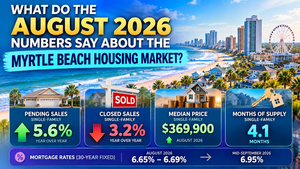
Buying a new-construction home in Myrtle Beach in 2026 means thinking beyond the base price on the brochure. Your real monthly payment blends mortgage principal and interest with taxes, insurance, HOA or POA fees, and often upgraded features that get rolled into the loan. With 30‑year fixed rates hovering a bit above 6% as of early February 2026, understanding how these pieces work together is the key to choosing the right community, floor plan, and budget for the Grand Strand.
The real monthly payment on a Myrtle Beach new home
When buyers ask about the monthly payment on a new-construction home in Myrtle Beach, they usually start with the mortgage amount and interest rate. As of February 5, 2026, the average 30‑year fixed rate was 6.11%, down from 6.89% a year earlier, which improves affordability compared with much of 2024–2025. On a typical $365,000 single‑family home—the current 12‑month median for the Coastal Carolinas region—20% down leaves a $292,000 loan, which at around 6.11% produces a principal and interest payment in the mid‑$1,700s before anything else is added.
Next comes property taxes, which in much of Horry County are lower than many major metros but still add a noticeable monthly cost when escrowed. Insurance also matters: coastal buyers should plan for standard homeowners coverage plus potential wind or named‑storm deductibles, which can vary by proximity to the ocean and construction details. New communities across Carolina Forest, Conway, and the wider Grand Strand often include HOA or POA dues for amenities and common‑area maintenance, which may range from modest fees in smaller neighborhoods to higher dues in master‑planned or resort‑style communities.
New construction also introduces upgrade decisions that change the payment even when the base price stays the same. Structural options, lot premiums, and design‑studio selections can shift a “from the mid‑$300s” home into the $400,000s, especially in high‑demand Myrtle Beach submarkets like Carolina Forest or near the Intracoastal Waterway. Because most buyers finance roughly three‑quarters of their purchase price nationally, every $10,000 in upgrades increases both the loan amount and the true monthly payment.
How 2025–2026 market trends affect Myrtle Beach payments
Local and national trends over the last year set the backdrop for what monthly payments look like today. Across the Coastal Carolinas region, the 12‑month median single‑family price ended 2025 at about $365,000, up 1.4% from 2024, while condo medians softened to roughly $238,825, down 3.7%. That means buyers looking at new‑construction condos or townhomes around Myrtle Beach may find relatively more price stability than in recent years, even as single‑family prices continue to edge up.
At the same time, inventory has improved compared with the tightest post‑pandemic years, which helps reduce bidding pressure. By December 2025, Coastal Carolinas single‑family inventory was about 3,416 listings with 3.7 months of supply, while condos stood near 2,881 listings and 7.0 months of supply. This shift toward more balanced conditions gives buyers more choice in Myrtle Beach and surrounding areas, which can translate into more room to negotiate closing costs, rate buydowns, or upgrades that indirectly change your total monthly cost.
Affordability has also ticked up, even with prices higher than before the pandemic. The single‑family Housing Affordability Index for the Coastal Carolinas region averaged 75 in 2025, unchanged from the prior year, while the condo index rose to about 114, indicating relatively better affordability in attached homes. Layer that onto the recent easing in mortgage rates into the low‑6% range as of early 2026 and the “real” monthly payment picture looks less strained than in 2023, especially for buyers open to a variety of Myrtle Beach sub‑areas and home types.
Estimating your total payment: key line items to watch
To get from list price to a concrete monthly payment on a new‑construction Myrtle Beach home, it helps to break your estimate into specific buckets. Start with principal and interest using current 30‑year fixed averages (around 6.11% nationally as of February 2026) and your expected down payment. Then add estimated property taxes and homeowners insurance, which your lender can escrow so those annual bills are spread across 12 months instead of arriving as one large expense.
Next, review HOA or POA dues for each community you are considering; in Grand Strand neighborhoods these fees often cover amenities, landscaping, or common‑area upkeep, and they are due whether or not you finance them. If your down payment is less than 20% on a conventional loan, build in private mortgage insurance (PMI) as another monthly line item. Many buyers in 2025 financed about 74% of their purchase price, so it is common for PMI or other credit‑related costs to be part of the real payment.
Finally, consider one‑time and lifestyle‑driven costs that do not show up in the mortgage quote but still matter month to month. Utilities for newer Myrtle Beach homes may be more efficient than older properties, yet square footage, number of stories, and features like pools still influence monthly outlays. Commuting patterns within Horry County, internet and cable packages available in your chosen community, and routine maintenance for things like irrigation systems or coastal landscaping will all affect what your home truly costs to own in 2026, even if they do not appear on your closing disclosure.
Carolina Crafted Homes stays current on Myrtle Beach market trends and can answer questions about the real monthly payment on a new‑construction home. Reach out anytime for guidance—no pressure, just straightforward expertise.
FAQS
Q1: How much does a typical new‑construction home cost in the Myrtle Beach area right now?
Local MLS data for the broader Coastal Carolinas region shows the 12‑month median single‑family sale price at about $365,000 as of December 2025. Condos and townhomes are lower, with a 12‑month median near $238,825, reflecting some price softening in attached homes over the year. Specific Myrtle Beach neighborhoods such as Carolina Forest, Conway, and North Myrtle Beach often run above or below these regional medians depending on proximity to the beach, amenities, and home size. New‑construction communities tend to cluster around or above the single‑family median because of modern features and building standards.
Q2: How do current mortgage rates affect my payment on a new‑construction home?
As of early February 2026, the national average 30‑year fixed mortgage rate is about 6.11%, down from 6.89% a year earlier. On a $365,000 home with 20% down, that rate range typically places the principal and interest payment in the mid‑$1,700s before taxes, insurance, or HOA fees. Even a small change in rate—such as half a percentage point—can shift the monthly cost by more than a hundred dollars, which is why many buyers compare scenarios or ask about permanent and temporary buydowns. New‑construction buyers in Myrtle Beach sometimes negotiate seller credits that can be applied to closing costs or rate improvements, indirectly lowering monthly payments.
Q3: Are new‑construction homes in Myrtle Beach more affordable than resale homes?
Affordability depends on more than age; it mixes price, taxes, insurance, rates, and HOA dues. In 2025 the single‑family Housing Affordability Index for the Coastal Carolinas region was about 75, while the condo index was around 114, suggesting attached homes were relatively more affordable for the typical household. New construction often commands a price premium but can compensate with lower maintenance, better energy efficiency, and modern systems that reduce surprise repair costs in the early years. Many buyers in Horry County weigh these trade‑offs, comparing slightly higher mortgage payments on a new home against potential savings on repairs and utilities compared with some older resale options.
Q4: How do HOA or POA fees in Myrtle Beach impact my monthly budget?
In many Myrtle Beach and Grand Strand communities, HOA or POA fees support amenities such as pools, clubhouses, lawn care, or gated access. While amounts vary by neighborhood and property type, they represent a fixed monthly or quarterly cost that is due regardless of mortgage structure. Because condo and townhome communities in the coastal area often include more shared elements, their dues can be higher than in some single‑family subdivisions, even when purchase prices are lower. Buyers comparing new‑construction options in areas like Carolina Forest, North Myrtle Beach, or Surfside Beach frequently review HOA budgets as carefully as they review floor plans to understand the true monthly obligation.
Q5: Do rising home prices mean my payment will keep going up every year?
Your base principal and interest payment on a fixed‑rate loan stays the same, but other components can adjust over time. Property taxes and insurance premiums may rise as local assessments and coverage costs change, which can increase the escrow portion of your monthly payment. In the Coastal Carolinas region, single‑family prices grew about 1.4% in 2025, while condos declined roughly 3.7%, highlighting that different segments can move in different directions. HOA or POA fees can also be adjusted periodically by community boards to reflect maintenance needs and amenity costs, so it is wise to review the association’s history of increases as part of your planning.
Q6: Are Myrtle Beach condos a good option for lowering my monthly payment?
Condos and townhomes can offer lower purchase prices than many single‑family homes, especially in resort‑oriented markets like Myrtle Beach. In 2025, the Coastal Carolinas condo median price was about $238,825 versus $365,000 for single‑family homes, and the condo affordability index was notably higher. However, condo buyers typically pay association dues that cover building exteriors, common areas, and amenities, so those costs need to be weighed against the savings on price. Many buyers who value walkable access to the beach or shared amenities accept a slightly higher HOA in exchange for a lower mortgage payment than a similarly located single‑family home would require.