TL;DR: Carolina Forest single-family homes hit a $520,000 median price in April 2026 while inventory dropped 24.2 percent year over year. Large wooded lots in the area are getting harder to find, and building on one raises site decisions a standard subdivision lot never does. Below, we walk through what that process looks like — plus a behind-the-scenes video from a build of our own.
A Different Kind of Lot
Carolina Forest has been one of the more active submarkets along the Grand Strand. According to CCAR MLS (April 2026), the median single-family sales price in Carolina Forest reached $520,000, up 19.8 percent from a year earlier, while inventory fell to 272 homes. Demand has stayed steady too — CCAR MLS (January 2026) recorded 10.4 showings per listing in Carolina Forest during 2025, among the highest in the coastal market.
Most of that activity involves finished lots inside established neighborhoods. Larger parcels are a different situation entirely. When a lot includes woods, water, or wetland areas, the design process starts with the land rather than the floor plan.
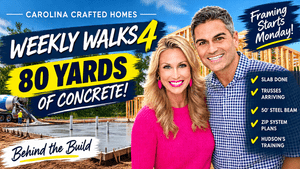
Walking the lot and talking through the pond, the wetlands, and the home plan.
What Building a Custom Home on Acreage in Carolina Forest Actually Involves
The video above covers a build of our own, and it opens with a decision most people don't expect: the original home plan didn't work.
The first plan featured a side-entry three-car garage. It was wide — wide enough that it would have consumed the side yard and eliminated future options for the rest of the parcel. So the plan was scrapped and redrawn from scratch, with the garage moved to one side and the primary suite oriented toward the heaviest tree cover.
That sequence is common on large parcels. A plan that performs well on a quarter-acre lot may waste the very features that made the acreage worth buying. For context, the average lot in the NAHB Construction Cost Survey (January 2025) measured 20,907 square feet — slightly under half an acre. A parcel several times that size behaves differently.
Questions that surface early on a larger lot:
Where does the house sit relative to views, tree lines, and water?
How far back from the street should it sit, and what does that cost the rear yard?
Does the driveway serve guests, everyday household parking, or both?
What parts of the parcel are buildable, and what parts are restricted?
Site Planning: Placement Drives Everything Else
In the video, the conversation shifts to sliding the house sideways so the primary suite, the bonus room, and the pool all look straight down the center of the pond. That's a small adjustment on paper with a large effect on how the finished home feels.
Setback distance turned into its own negotiation — one person wanted the house 60 to 65 feet back from the street, the other pushed for 85 feet to preserve rear yard depth. There's no universally correct answer. Pushing the home back deepens the front approach and shortens the backyard. Pulling it forward does the reverse.
Driveway configuration follows the same logic. A circular front drive handles guest parking and gives the elevation a formal presentation. A rear drive to a detached or side-loaded garage keeps daily traffic out of the main view. On a large lot, you can often do both — but each foot of pavement is a real line item.
Site Costs Are a Bigger Variable on Large Parcels
Buyers usually focus on cost per square foot. On acreage, the land-related components matter more.
According to the NAHB Construction Cost Survey (January 2025), the finished lot accounted for 13.7 percent of the average new-home sales price, while site work made up 7.6 percent of total construction cost. Those national averages don't reflect Horry County conditions, but they show where the money concentrates.
Land-Related Cost Components as a Share of Construction Cost
| Cost Component | National Average | Share of Construction Cost |
|---|---|---|
| Site work (total) | $32,719 | 7.6% |
| Excavation, foundation, concrete, backfill | $43,002 | 10.0% |
| Driveway | $9,635 | 2.3% |
| Landscaping | $9,269 | 2.2% |
| Building permit fees | $7,640 | 1.8% |
| Architecture and engineering | $6,480 | 1.5% |
| Outdoor structures (deck, patio, porches) | $4,722 | 1.1% |
Source: NAHB Construction Cost Survey (January 2025). National averages; figures are not specific to Horry County or the Grand Strand.
Longer driveways, extended utility runs, and larger cleared areas all scale with distance. Those items sit inside the same categories above, but the quantities change.
Permitting and Land Conditions in Unincorporated Horry County
Carolina Forest sits in unincorporated Horry County, so county rules apply rather than any city ordinance. According to Horry County SC.Gov Build Responsibly guidance, a permit is required in unincorporated areas of the county for construction or improvement of any building costing more than $500, including materials and labor.
Flood zone designation matters as well. That same guidance specifies that buildings in an AE flood zone must be elevated so the lowest floor sits at least three feet above base flood elevation, verified by a finished-construction elevation certificate. In a Zone A without an established base flood elevation, the lowest floor must sit at least 24 inches above the highest adjacent grade.
Land conditions add another layer. Parcels with ponds, standing water, or wooded low areas may include regulated wetlands, and boundaries need to be professionally delineated before design is finalized. Site-specific requirements — buffers, protective fencing during construction, and permitted activity within those areas — vary by parcel and by agency. Consult with a licensed professional and confirm requirements with Horry County for your specific situation before making design commitments.
If you're weighing a larger parcel in Carolina Forest or elsewhere in Horry County, the placement question usually comes before the plan question — and it's easier to answer with someone who has walked the site. We're documenting our own build from the lot forward, so follow along on the video series. When you're ready to talk through what a specific parcel can support, reach out to our team and we'll help you think it through.
FAQ SECTION
How much land do you need to build a custom home in Carolina Forest?
There's no single answer, because it depends on the home's footprint, setback requirements, and how much of the parcel is actually buildable. For context, the average lot in the NAHB Construction Cost Survey (January 2025) measured 20,907 square feet, just under half an acre. Larger parcels give you more flexibility on placement, driveway design, and outdoor space, but they also mean longer utility runs and more area to maintain. A site evaluation is the reliable way to find out what a specific parcel supports.
Does the home plan have to be finalized before choosing a lot?
Not necessarily, and sometimes it shouldn't be. In our own build, the original plan was set aside after we walked the lot, because a wide side-entry garage would have consumed space we wanted to keep open. Redrawing the plan around the land produced a better result. If you already have a plan you love, bring it to the site evaluation early so any conflicts surface before you're committed.
Do I need a permit to build on acreage in unincorporated Horry County?
Yes. According to Horry County SC.Gov Build Responsibly guidance, a permit is required in unincorporated areas of the county when construction or improvement to any building exceeds $500 in cost, including materials and labor. Flood zone designation may add elevation requirements and an elevation certificate. Requirements vary by parcel, so confirm specifics with Horry County Code Enforcement and consult a licensed professional for your situation.
How far back from the street should a house sit on a large lot?
That's a design and code question combined. Minimum setbacks are set by local requirements, but beyond the minimum it becomes a trade-off: pushing the home back lengthens the front approach and shortens the rear yard, while pulling it forward does the opposite. In our own build it took an actual negotiation between a 60-to-65-foot setback and an 85-foot setback. Verify applicable setback requirements for your parcel with Horry County before finalizing placement.
What should I know about a lot with a pond or wooded low areas?
Water features and low-lying wooded areas can carry regulatory implications, including potential wetland designation. Boundaries need professional delineation before design is finalized, and permitted activity within those areas is determined by the governing agencies. Utility access is a separate consideration — extending power to distant points on a parcel adds cost that scales with distance. Have these questions answered during due diligence, not after closing, and work with licensed professionals throughout.
Is Carolina Forest still an active market for new construction?
CCAR MLS (April 2026) reported a Carolina Forest single-family median sales price of $520,000, up 19.8 percent year over year, with inventory down 24.2 percent to 272 homes. CCAR MLS (January 2026) recorded 10.4 showings per listing in the area during 2025. Homes received 98.3 percent of list price in April 2026. Current data shows sustained interest alongside constrained supply, which is part of why buildable parcels draw attention.
Sources
Coastal Carolinas Association of REALTORS® (CCAR MLS): https://www.ccarsc.org/pages/marketstats/
National Association of Home Builders — Cost of Constructing a Home 2024: https://www.nahb.org/news-and-economics/housing-economics-plus/special-studies/special-studies-pages/cost-of-constructing-a-home-in-2024
Horry County Government: https://horrycountysc.gov/