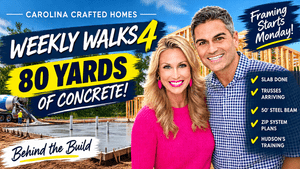
TL;DR: Months of work happen on a custom home site before any concrete gets poured. This post follows the pre-construction stage of a nine-acre build in unincorporated Horry County — lot closing, plan design, permitting, and site prep — using footage from the first Weekly Walk video. It also breaks down what site work typically costs and what the county requires before construction can begin.
Watch the First Weekly Walk
The Grand Strand's new construction story usually starts long before a framing crew shows up. According to CCAR MLS data for the Carolina Forest area (April 2026), single-family inventory dropped 24.2% year over year to 272 homes. Over the same period, the median sales price climbed 19.8% to $520,000. With fewer existing homes on the market, more buyers across Horry County are weighing a build instead. What most of them never see is the stretch of work between closing on a lot and digging a foundation. The video below is the first in a series documenting exactly that — a real build, on a real site, in real time.
From a February Closing to an August Permit
The lot closed in February. Frank and Tiffany first walked it the winter before that, which means the property was under consideration for roughly two months before the deal was done.
Everything after that was preparation. Plan design took several rounds of back-and-forth. Selections — finishes, fixtures, materials — were locked in early rather than decided mid-build. That front-loading is deliberate. Decisions made on paper cost far less than decisions made after framing.
By early August, the permit was in hand. The lot had been scraped. Brush was cleared along the front so a silt fence and temporary construction drive could go in. Both are required before vertical construction starts.
Still on the list: an architectural review board meeting and posting the address on the site. Foundation work follows once those items clear.
That is roughly six months between closing and excavation. Nothing about it was unusual. It is simply what the timeline looks like when the prep is done properly.
What the Custom Home Build Process Looks Like Before the Foundation
Buyers often assume construction spending begins with the slab. It does not. A meaningful share goes out the door during site work — the stage where nothing visible has been built yet.
According to the NAHB Construction Cost Survey (January 2025), site work accounted for 7.6% of total construction cost on a typical single-family home built in 2024. Foundations added another 10.5%. Together, that is roughly a fifth of the construction budget spent before the first wall goes up.
Table: Pre-construction and foundation costs on a typical single-family home, 2024 national averages
| Cost Category | Average Cost | Share of Construction Cost |
|---|---|---|
| Building permit fees | $7,640 | 1.8% |
| Architecture and engineering | $6,480 | 1.5% |
| Impact fees | $6,367 | 1.5% |
| Water, sewer fees and inspections | $6,260 | 1.5% |
| Total site work | $32,719 | 7.6% |
| Excavation, foundation, concrete, backfill | $43,002 | 10.0% |
Source: NAHB Construction Cost Survey (January 2025). Figures are national averages for a typical home of 2,647 finished square feet on a 20,907-square-foot lot. Costs in Horry County will differ based on site conditions, lot size, and scope.
Site conditions drive a lot of this. A nine-acre parcel with a pond behind it carries different clearing, grading, and drainage work than a quarter-acre lot on flat ground. That is why site work is estimated per property, not per plan.
Permits and Site Prep Rules in Unincorporated Horry County
Jurisdiction matters here. Rules in unincorporated Horry County are not the same as those inside the City of Myrtle Beach, North Myrtle Beach, or Surfside Beach.
Per Horry County's Build Responsibly guidance (accessed July 2026), a permit is required in unincorporated areas of the county whenever construction or improvement to a building costs more than $500, including materials and labor. That threshold is low by design and catches far more work than most owners expect.
Flood zone requirements add another layer. The county's guidance states:
In an AE zone, the lowest floor must sit at least 36 inches above base flood elevation
In a VE zone, the bottom of the lowest supporting horizontal member must sit at least 36 inches above base flood elevation
In an A zone with no established base flood elevation, the lowest floor must sit at least 24 inches above the highest adjacent grade
A finished construction elevation certificate verifies the height in AE and VE zones. In an A zone, the building inspector verifies it, and a certificate must be completed by the owner or a licensed surveyor or engineer.
On this particular build, the county returned the permit faster than the posted window suggested, shortly after moving to electronic submittals. That reflects one project's experience, not a published turnaround standard. Consult with a licensed professional for your specific situation, and confirm current requirements with Horry County Code Enforcement before making decisions.
Why Buyers Along the Grand Strand Look at Building
The appeal is not mysterious. According to the NAR Profile of Home Buyers and Sellers (2025), 43% of new home buyers chose new construction to avoid renovations or problems with plumbing and electrical systems. Another 22% wanted the ability to choose and customize design features.
That second group is doing what this build is doing — making decisions early, on purpose, instead of inheriting someone else's.
Local numbers add context. In the Carolina Forest area, single-family homes took a median 129 days to sell in April 2026, up 4.9% year over year, per CCAR MLS. Homes are not moving quickly, but inventory is tight and prices have held. Buyers who cannot find what they want on the market have a real alternative.
The same NAR report (2025) found that buyers of new homes purchased a median 2,000 square feet, compared with 1,800 square feet for previously owned homes. Detached single-family homes remained the most common purchase at 76%.
If you have watched the video and found yourself wondering what your own lot would require before construction could start — clearing, grading, drainage, permits — that is a question worth asking early rather than after closing. Every site answers it differently. We are happy to walk through what the process looks like for a specific property, with no obligation attached. Reach out to start the conversation.
FAQ SECTION
How long does the custom home build process take before construction starts?
It varies by site, but the pre-construction stage is longer than most buyers expect. On the build shown in this video, the lot closed in February and the permit was issued in early August — roughly six months. That window covered plan design revisions, material and finish selections, permit submittal, and site clearing. Lots with drainage considerations, wetlands, or architectural review requirements generally take longer than flat, previously cleared parcels. Front-loading design decisions tends to reduce delays later, since changes made after framing cost significantly more than changes made on paper.
Do I need a permit to build in unincorporated Horry County?
Yes. According to Horry County's Build Responsibly guidance, a permit is required in the unincorporated areas of the county when construction or improvement to any building costs more than $500, including both materials and labor. That threshold applies to far more work than new construction alone. Requirements differ inside incorporated municipalities such as the City of Myrtle Beach, North Myrtle Beach, and Surfside Beach, so confirm which jurisdiction governs your parcel before planning. Consult with a licensed professional for your specific situation.
What is site work, and how much of the budget does it take?
Site work covers everything that prepares a lot for construction: permit fees, impact fees, water and sewer connections, architecture and engineering, clearing, and erosion control measures like silt fencing. According to the NAHB Construction Cost Survey (January 2025), site work averaged 7.6% of total construction cost nationally in 2024, or about $32,719. Foundations added another 10.5%. Those figures are national averages on a 20,907-square-foot lot. Larger parcels, sloped ground, or sites near water bodies typically require more clearing and drainage work than the average.
Why are more Grand Strand buyers considering new construction?
Two reasons dominate. The NAR Profile of Home Buyers and Sellers (2025) found that 43% of new home buyers wanted to avoid renovations or problems with plumbing and electrical systems, and 22% wanted to choose and customize design features. Local inventory conditions reinforce that. CCAR MLS reported single-family inventory in the Carolina Forest area down 24.2% year over year in April 2026, with the median sales price up 19.8% to $520,000. When the existing market does not offer what a buyer needs, building becomes a practical alternative.
Does a flood zone designation change what I can build?
It changes elevation requirements. Horry County's Build Responsibly guidance states that buildings in an AE zone must have the lowest floor at least 36 inches above base flood elevation. In a VE zone, the bottom of the lowest supporting horizontal member must meet that same 36-inch standard. In an A zone with no established base flood elevation, the lowest floor must sit at least 24 inches above the highest adjacent grade. A finished construction elevation certificate verifies compliance. Verify your parcel's designation before finalizing plans, and consult a licensed surveyor or engineer.
What happens after the foundation is poured?
Framing follows, then exterior finishes, mechanical rough-ins, and interior finishes. The NAHB Construction Cost Survey (January 2025) shows interior finishes as the largest single stage at 24.1% of construction cost, followed by major system rough-ins at 19.2% and framing at 16.6%. Weather affects the outdoor stages most. Rain delays site work, foundation pours, and framing far more than it affects interior work. This series will continue documenting each stage on the same property as it progresses.
Sources
Coastal Carolinas Association of REALTORS® (CCAR MLS, Local Market Update, April 2026): https://www.ccarsc.org/pages/marketstats/
National Association of REALTORS®, Profile of Home Buyers and Sellers (2025): https://www.nar.realtor/
National Association of Home Builders, Cost of Constructing a Home 2024 (January 2025): https://www.nahb.org/news-and-economics/housing-economics-plus/special-studies/special-studies-pages/cost-of-constructing-a-home-in-2024
Horry County Government, Build Responsibly: https://horrycountysc.gov/