TL;DR: A Myrtle Beach rental purchase works when rent covers the loan payment, taxes, insurance, and upkeep with room to spare. Current CCAR data shows condos and single-family homes moving differently, and 30-year rates sit near 7%. Start with debt service, then test every other cost against real quotes.
Investors looking at the Grand Strand face a split market. According to the Coastal Carolinas Association of REALTORS® (CCAR, October 2026), single-family homes across Georgetown and Horry Counties carried a 4.2-month supply, while condos carried 7.5 months. In the Myrtle Beach ZIP codes (29572 and 29577), the condo median price was $205,000 through October 2026, down from $228,000 a year earlier. Meanwhile, FRED reports the 30-year mortgage rate at 6.95% for the week of September 17, 2026. Those numbers shape every rental analysis. This guide shows how to underwrite a Grand Strand rental: debt service first, then market signals, then the costs most listings leave out.
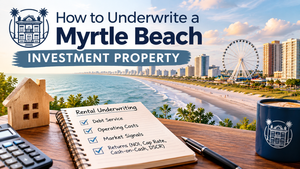
How to Underwrite a Myrtle Beach Investment Property
Underwriting means testing whether a property’s income supports its costs before you buy. Four measures do most of the work:
Net operating income (NOI): rental income minus vacancy and operating expenses, before loan payments.
Cap rate: NOI divided by the purchase price.
Cash-on-cash return: yearly cash flow after loan payments, divided by the cash you invested.
Debt service coverage ratio (DSCR): NOI divided by yearly loan payments. It shows how many times income covers the loan.
Rental income is the input that needs the most care. The approved sources behind this post do not include Grand Strand rent or occupancy figures, so we do not print any here. Instead, gather at least two independent sources for each property. For a long-term rental, that means local rent comparables. For a short-term rental, it means booking history from the current owner and a check of local rental rules.
Nationally, investor and second-home activity is a steady slice of the market. According to the NAR REALTORS® Confidence Index (February 2026), 16% of sales were for non-primary residence use, which includes vacation use and residential rental. Our Myrtle Beach investing guide walks through how to organize this research before you make an offer.
Step 1: Test the Loan Payment at Today’s Rates
Debt service sets the floor your rent has to clear. According to FRED (September 17, 2026), the 30-year fixed mortgage rate averaged 6.95%. That is the most recent weekly reading in our current files, so check today’s rate before you run your own numbers.
That series tracks a national benchmark. A loan on a rental property is quoted separately, so ask a lender for actual terms. Programs and rates subject to change; verify current details.
The table below shows what the payment looks like at recent median prices. It is arithmetic, not a forecast.
Illustrative principal-and-interest payments at recent Grand Strand median prices (assumes 25% down, 30-year fixed at 6.95%)
| Property type and area | Median price | Monthly P&I | Yearly P&I |
|---|---|---|---|
| Condo, Georgetown and Horry Counties (Oct. 2026) | $230,750 | $1,146 | $13,747 |
| Single-family, Georgetown and Horry Counties (Oct. 2026) | $365,000 | $1,812 | $21,745 |
| Condo, Myrtle Beach ZIP codes (year to date through Oct. 2026) | $205,000 | $1,018 | $12,213 |
| Single-family, Myrtle Beach ZIP codes (year to date through Oct. 2026) | $525,000 | $2,606 | $31,277 |
Source: According to CCAR MLS (October 2026) for prices and FRED (September 17, 2026) for the 6.95% rate. Payments calculated by Carolina Crafted Homes; they exclude property taxes, insurance, and HOA dues.
Rent has to clear these payments first. Taxes, insurance, dues, management, and repairs come out of what is left.
Step 2: Compare Condo and Single-Family Signals
Property type changes the picture in Myrtle Beach. CCAR data for October 2026 shows these contrasts:
Months of supply: 4.2 for single-family homes and 7.5 for condos across Georgetown and Horry Counties.
Median price: $365,000 for single-family homes (unchanged from a year earlier) and $230,750 for condos (down 1.6%).
Days on market: 114 for single-family homes and 133 for condos, with 97.3% and 96.0% of list price received.
Myrtle Beach ZIP codes, condos (year to date): 1,318 closed sales, 141 days on market, and 94.8% of list price received.
Myrtle Beach ZIP codes, single-family (year to date): 508 closed sales, 131 days on market, and 96.2% of list price received.
Buyer traffic matters too. According to the CCAR Showings Report (October 2026), Myrtle Beach recorded 5,731 showings, down 8.7% from a year earlier, or 1.9 showings per listing.
Current data shows deeper condo inventory and sales closing below asking price in the Myrtle Beach ZIP codes. That gives investors room to compare properties and negotiate terms. It also means a property may take longer to sell if plans change.
Price matters here as well. A $230,750 condo and a $365,000 single-family home produce very different payments, as the table above shows. They also carry different dues, insurance needs, and upkeep. Underwrite each property type on its own numbers rather than blending them into one average.
Competition still varies by buyer. According to the NAR REALTORS® Confidence Index (February 2026), 31% of sales nationally were cash purchases.
Step 3: Price the Costs the Listing Doesn’t Show
A listing shows price and dues. It rarely shows the full cost of ownership. Before you finalize an analysis, get written quotes for these items:
Wind and flood insurance
Property taxes for a non-owner-occupied property
HOA dues, special assessments, and any rental restrictions
Property management and maintenance reserves
Local licensing and rental rules
Flood zone status deserves early attention along the Grand Strand. According to Horry County Government (Build Responsibly page, reviewed July 2026), the National Flood Insurance Program requires a building to meet new-construction standards when improvements or repairs cost 50% or more of its market value. The county also requires new buildings in AE flood zones to sit at least three feet above base flood level.
For an older rental you plan to renovate, that 50% threshold can change your budget. Ask for the flood zone and any elevation certificate before you make an offer.
Rules also differ by location. The City of Myrtle Beach, North Myrtle Beach, Surfside Beach, and unincorporated Horry County each maintain their own codes. Finally, rental income and depreciation carry tax consequences. Consult a licensed tax professional about your specific situation.
Every Grand Strand rental starts with one question: does the rent clear the payment, taxes, insurance, and upkeep once real quotes are in? If you have a condo or single-family home in mind, we can help you map those costs against current CCAR data, flood zone details, and local rental rules before you decide. There is no pressure and no set timeline. Whenever you are ready, start the conversation.
FAQ
What cap rate should I look for on a Myrtle Beach investment property?
No single cap rate applies across the Grand Strand, and the sources behind this guide do not publish local cap rates. A practical check is to compare the property’s cap rate with your loan rate. FRED showed a 30-year benchmark of 6.95% on September 17, 2026. A cap rate far below your borrowing cost means the loan costs more than the property earns before any change in price. Build the cap rate from your own quotes for rent, taxes, insurance, and dues. This is general education, not financial advice.
Are condos or single-family homes the better rental in Myrtle Beach?
Neither wins on market data alone. According to CCAR (October 2026), Georgetown and Horry Counties had 4.2 months of single-family supply and 7.5 months for condos. The median price was $365,000 for single-family homes and $230,750 for condos. Those gaps affect payment size, dues, insurance, and how long a property may take to sell. The better fit is the one whose verified rent, after every cost, clears your loan payment. Run both types through the same underwriting steps.
How much down payment do I need for a rental property?
Lender requirements vary, and the sources behind this guide do not list investor loan terms. The table above assumes 25% down only to show how payments scale. Lenders set their own minimums, pricing, and reserve rules for rental purchases. Ask for written quotes from more than one lender that show the rate, fees, and cash required at closing. Rates and programs are as of November 2026 and subject to change; verify current details with your lender.
Can I use a Myrtle Beach property as a short-term rental?
It depends on the exact address and community. The City of Myrtle Beach, North Myrtle Beach, Surfside Beach, and unincorporated Horry County each maintain their own codes, and HOAs can add restrictions. Confirm the rules for the specific property, plus any licensing or tax registration, before you make an offer. Our post on short-term rental rules in Myrtle Beach covers this in more detail. Consult with a licensed professional for your specific situation.
Does a flood zone affect a rental purchase in Horry County?
It can. According to Horry County Government (Build Responsibly page, reviewed July 2026), the National Flood Insurance Program requires a building to meet new-construction standards when improvements or repairs cost 50% or more of its market value. New buildings in AE flood zones must sit at least three feet above base flood level. Ask for the flood zone and any elevation certificate early. Then get an insurance quote before you finalize your numbers.
Will I compete with cash buyers for a Grand Strand rental?
Possibly. According to the NAR REALTORS® Confidence Index (February 2026), 31% of sales nationally were cash purchases. That figure is national, not specific to the Grand Strand. Locally, CCAR (October 2026) shows single-family homes sold at 97.3% of list price and condos at 96.0%. Those figures describe recent closed sales across Georgetown and Horry Counties. They do not predict the outcome of any single offer.
Sources
Coastal Carolinas Association of REALTORS® (Local Market Update, Monthly Indicators, Showings Report, October 2026): https://www.ccarsc.org/pages/marketstats/
FRED Economic Data (30-Year Fixed Mortgage Rate): https://fred.stlouisfed.org/
National Association of REALTORS® (REALTORS® Confidence Index, February 2026): https://www.nar.realtor/
Horry County Government (Build Responsibly): https://horrycountysc.gov/