TL;DR: Myrtle Beach heads into late 2026 with single-family prices holding near $368,000 — well below the national median of $408,800 — plus growing inventory and one of the strongest new-construction pipelines on the coast. The trade-offs are real: coastal building rules, flood zone requirements, and a soft condo market all deserve a clear-eyed look before you commit to retiring here.
If you're weighing whether Myrtle Beach is a good place to retire, you're asking the question at an interesting moment. According to NAR's 2025 Profile of Home Buyers and Sellers, the median home buyer in America is now 59 years old — a record high — and repeat buyers, at a median age of 62, make up the largest share of the market. In other words, buyers approaching or entering retirement are now the center of gravity in American real estate. The Grand Strand has long attracted this group. But "popular" and "right for you" aren't the same thing. Here's an honest look at both sides, grounded in current data.
Is Myrtle Beach a Good Place to Retire in 2026? Start With the Market
The strongest argument for retiring to Myrtle Beach right now is simple: conditions favor buyers more than they have in years.
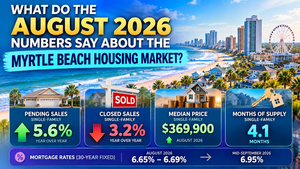
According to CCAR MLS Monthly Indicators (April 2026), the regional single-family median sales price held flat year-over-year at $368,000. Compare that to the national picture. NAR data cited in the same report puts the U.S. median existing-home price at $408,800 as of April 2026 — roughly $40,000 higher than the Coastal Carolinas region.
Buyers also have room to negotiate and time to decide:
Days on market: 125 days for single-family homes (April 2026)
Months supply: 4.3 months for single-family — near balanced-market territory
Percent of list price received: 97.6%, meaning modest negotiating room is normal
The CCAR Annual Report (2025) characterized 2026 as a year of stabilization rather than dramatic change, with mortgage rates expected to hold in the 6% range and modest price movement. For a buyer who wants to shop carefully — visit twice, compare communities, get inspections without pressure — this is a workable environment. There's no urgency premium built into today's Grand Strand market.
Coastal Carolinas Market Snapshot — April 2026
| Metric | Single-Family | Condo |
|---|---|---|
| Median Sales Price | $368,000 (flat YoY) | $231,000 (−7.6% YoY) |
| Days on Market | 125 | 131 |
| Months Supply of Inventory | 4.3 | 8.1 |
| Percent of List Price Received | 97.6% | 96.0% |
Source: CCAR MLS Monthly Indicators (April 2026)
The Pros: Housing Options Built for the Way You Want to Live
Beyond price, the Grand Strand offers something many retirement destinations can't: choice in how your home is built.
According to the CCAR Annual Report (2025), 33.7% of all closed sales in Horry County were new construction — one of the highest new-build shares you'll find in a coastal market. That matters if your next home needs to work differently than your last one. NAR's 2025 Profile found that among buyers over 60 who purchased senior-related housing, 60% chose a detached single-family home. Features like single-level floor plans, zero-step entries, wider doorways, and low-maintenance exteriors are far easier to get in a home designed for them from the start than retrofitted into a 1990s resale.
There's also a commitment signal worth noting. NAR (2025) reports that 28% of recent buyers say they're never moving again, and the median buyer expects to stay 15 years. If this is your long-horizon home, design decisions carry more weight — which is exactly the case for building intentionally. Our guide to designing a forever home on the coastal South Carolina shore walks through what aging-in-place construction actually involves.
One more practical advantage: liquidity on the buyer side. NAR (2025) found 26% of all buyers — and 30% of repeat buyers — paid cash. Sellers relocating with equity from a prior home enter this market with genuine negotiating strength.
The Cons: Coastal Rules, Insurance Questions, and a Soft Condo Segment
An honest Myrtle Beach retirement pros and cons list has to include the coastal realities.
Flood zones shape what and where you can build. According to Horry County's Build Responsibly guidance, homes constructed in an AE flood zone must have the lowest floor elevated at least 3 feet above base flood elevation, verified by a finished-construction elevation certificate. VE and unnumbered A zones carry their own elevation rules. These requirements protect you — but they add cost and constrain lot selection, so flood zone status should be one of your first questions on any property, not an afterthought.
Insurance costs need independent verification. Coastal homeowners insurance, wind and hail coverage, and flood insurance premiums vary widely by elevation, construction type, and carrier. Current approved data on Grand Strand premium levels isn't available in our source set, so get binding quotes for specific properties before you commit — not after.
The condo market is genuinely soft. CCAR MLS (April 2026) shows condo median prices down 7.6% year-over-year with 8.1 months of supply. That cuts both ways: it's an opportunity if you're buying a lock-and-leave condo, but a caution if you're counting on near-term appreciation or planning to sell one later.
Seasonality is real. Summer tourism brings traffic and crowds to oceanfront corridors. Many long-term residents choose locations a few miles inland — Carolina Forest, Conway, and similar areas — partly for that reason.
Planning the Move: Building Costs, Taxes, and Timing
If new construction is on your list, know the national benchmarks. The NAHB Construction Cost Survey (January 2025) found construction costs averaged $162 per square foot nationally in 2024, with construction accounting for 64.4% of a typical new home's final price. Local figures vary with lot conditions and finishes, but the survey is a useful reality check when comparing builder quotes. Note this is 2024 survey data — the most recent available.
On taxes: South Carolina is widely regarded as tax-friendly for homeowners at the primary-residence assessment rate, and sellers should understand how South Carolina treats capital gains on a home sale. Specific property tax figures, exemption amounts, and retirement income treatment weren't available in our current approved sources, so verify current numbers with the SC Department of Revenue and consult a licensed tax professional for your specific situation.
Finally, timing. With 4.3 months of single-family supply and 125-day market times as of April 2026, you can approach this decision methodically. Visit in both summer and winter. Compare a resale purchase against a build. Get flood zone determinations early.
So — is Myrtle Beach a good place to retire in 2026? The data supports a qualified yes: below-national pricing, buyer-friendly conditions, and unusual depth in new construction, balanced against coastal building requirements and insurance questions that demand homework. If you're comparing a resale purchase against building a home designed around single-level living and long-term accessibility, that's a conversation worth having with a local builder who knows Horry County's flood zones and permitting firsthand. When you're ready to talk through your specific situation, reach out to start the conversation.
FAQ SECTION
Is Myrtle Beach affordable compared to other places to retire?
On housing, yes — relative to the national market. According to CCAR MLS (April 2026), the regional single-family median price was $368,000, compared to a national median existing-home price of $408,800 reported by NAR for the same period. Condos ran considerably lower at a $231,000 median. Total affordability depends on more than the purchase price, though: insurance, property taxes, and healthcare costs all factor in and vary by property and personal situation, so build a complete budget before deciding.
Is 2026 a good time to buy a retirement home in Myrtle Beach?
Current data shows buyer-friendly conditions. CCAR MLS (April 2026) reported 4.3 months of single-family supply, 125 days on market, and sellers receiving 97.6% of list price — an environment with negotiating room and no urgency premium. The CCAR Annual Report (2025) projected 2026 as a year of stabilization with modest price movement. Conditions can change, so verify current data when you're ready to act, and evaluate timing against your own finances rather than market predictions.
Should I buy an existing home or build new in the Myrtle Beach area?
Horry County offers unusual depth in new construction — 33.7% of 2025 closed sales were new builds, according to the CCAR Annual Report (2025). Building makes the most sense when your needs are specific: single-level living, zero-step entries, wider doorways, or a floor plan designed for long-term accessibility. Resales can offer established landscaping and faster move-in. Compare total costs, including any renovation a resale would need to match the features you want.
What should I know about flood zones before buying near Myrtle Beach?
Check the flood zone designation on any property early. Per Horry County's Build Responsibly guidance, homes in AE zones must be elevated at least 3 feet above base flood elevation, verified by an elevation certificate, with separate rules for VE and A zones. Zone status affects construction requirements, insurance costs, and resale considerations. A local builder or the Horry County Code Enforcement office can help you confirm a specific parcel's designation before you commit.
Are condos a good option for retiring to Myrtle Beach?
They can be, with eyes open. CCAR MLS (April 2026) showed condo median prices down 7.6% year-over-year with 8.1 months of supply — a soft segment that gives buyers leverage but offers less near-term appreciation potential. Condos suit buyers who want lock-and-leave convenience and minimal exterior maintenance. Review HOA fees, insurance master policies, and any special assessments carefully, since these ongoing costs matter as much as the purchase price over a long ownership horizon.
Does South Carolina offer tax advantages for retirees who buy a home?
South Carolina applies a favorable assessment rate to owner-occupied primary residences, and the state offers various provisions worth researching through the SC Department of Revenue. Specific rates, exemption amounts, and retirement income treatment change over time and depend on your circumstances, so consult a licensed tax professional before making relocation decisions based on tax assumptions. If you'll be selling a home elsewhere first, capital gains treatment on that sale deserves equal attention.
Sources
CCAR MLS Monthly Indicators, April 2026: https://www.ccarsc.org/pages/marketstats/
CCAR Annual Report on the Coastal Carolinas Housing Market, 2025: https://www.ccarsc.org/pages/marketstats/
NAR 2025 Profile of Home Buyers and Sellers: https://www.nar.realtor/
NAHB Construction Cost Survey (January 2025): https://www.nahb.org/news-and-economics/housing-economics-plus/special-studies/special-studies-pages/cost-of-constructing-a-home-in-2024
Horry County SC.Gov — Build Responsibly: https://horrycountysc.gov/
SC Department of Revenue: https://dor.sc.gov/tax/individual-income