TL;DR: Building a new home in South Carolina moves through a fixed sequence of construction stages, and your total timeline depends on the lot, permits, and finish choices more than any single number. Across the Grand Strand, new construction made up roughly a third of the 2025 market, and coastal steps like flood-elevation certificates can add time to a build.
New construction is a major part of how people buy homes here — not a niche. According to the 2025 Annual Report on the Coastal Carolinas Housing Market (CCAR MLS, 2025), new construction accounted for 36.1% of closed sales across the entire market and 33.7% in Horry County. That means thousands of local buyers each year are asking the same question: how long will my home actually take to build? The honest answer is that a build follows a predictable order of steps, but the calendar shifts based on your site, your permits, and the choices you make along the way.
How Long Does It Take to Build a New Home in South Carolina?
There is no single fixed timeline that fits every project, and anyone who quotes one number is oversimplifying. A build is a sequence of stages that must happen in order, and each stage can move faster or slower depending on weather, labor, materials, and inspections.
What you can count on is the order of the work. According to the NAHB Construction Cost Survey (2024), a typical single-family home is built in these stages:
Site work and permits
Foundation
Framing
Exterior finishes
Major systems rough-ins (plumbing, electrical, HVAC)
Interior finishes
Final steps (landscaping, driveway, cleanup)
The same survey notes the average new single-family home measured about 2,647 square feet. Larger or more custom homes generally take longer because there is simply more work at each stage. A realistic schedule comes from mapping your specific plan against these phases — not from a stock estimate. Our post on why new build timelines are wrong digs into why generic numbers so often miss.
The Build Phases, In Order
Every home follows the same construction logic, and understanding it helps you read your own timeline. Site work comes first: clearing, grading, and pulling permits. Then the foundation is poured and cured. Framing follows, giving the home its shape and roof.
After the shell is up, the major systems go in — rough plumbing, electrical, and HVAC — followed by insulation and drywall. Interior finishes come next: cabinets, countertops, flooring, paint, and fixtures. Final steps close things out with landscaping, the driveway, and cleanup.
According to the NAHB Construction Cost Survey (2024), interior finishes represent the single largest share of construction cost at 24.1%, followed by major systems rough-ins at 19.2%. Those are also the stages where finish selections and change orders tend to stretch the schedule most. If you want a deeper walkthrough, our custom home process guide covers each decision point.
What Adds Time in Myrtle Beach and Horry County
Coastal building carries extra steps that inland projects may not. In the unincorporated parts of the county, a permit is required for any construction or improvement above $500 in cost, according to Horry County Government (2026). Permitting and inspections are built into the schedule, not bolted on at the end.
Flood zones add another layer. Per Horry County Government (2026), homes in AE and VE flood zones must be elevated so the lowest floor sits at least three feet above the base flood level, and that height must be confirmed with a "finished construction" elevation certificate from a licensed surveyor or engineer. These requirements protect the home, but they add design, survey, and inspection steps that affect the calendar.
Local permit review pace matters too. Our Horry County building permit timeline post breaks down that step in detail, and the inspection guide explains what inspectors check along the way.
Where New Construction Is Happening on the Grand Strand
New-build activity is not spread evenly across the region — it concentrates in specific submarkets. That matters because higher new-construction areas often have more active builders, lots, and infrastructure geared toward building.
Here is the share of 2025 closed sales that were new construction, by area:
New Construction Share of 2025 Closed Sales — Selected Grand Strand Areas
| Area | 2025 Closed Sales | New Construction Share |
|---|---|---|
| Horry County | 16,796 | 33.7% |
| Loris / Longs | 1,790 | 64.0% |
| Aynor | 137 | 49.4% |
| Carolina Forest | 1,582 | 42.4% |
| Socastee | 1,575 | 41.4% |
Source: CCAR MLS, 2025 Annual Report on the Coastal Carolinas Housing Market (2025)
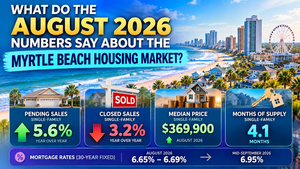
Broader conditions support building activity too. According to CCAR MLS (April 2026), single-family months supply sat at 4.3, with a median single-family sales price of $368,000. A market with steady demand and measured inventory is one where a new build can be a sensible path rather than competing for scarce resale listings.
If you're weighing a build and want a realistic schedule mapped to your specific lot, permits, and flood zone rather than a generic estimate, start the conversation with our team. We can walk you through each phase, flag the coastal steps that apply to your site, and give you a timeline grounded in how construction actually moves in Horry County.
FAQ
How long does it take to build a new home in South Carolina?
There is no single fixed number, because a build follows a set sequence of stages and each one can move faster or slower. According to the NAHB Construction Cost Survey (2024), the stages run from site work and foundation through framing, systems rough-ins, interior finishes, and final steps. Your total timeline depends on the size of the home, your lot, the permit process, and how quickly finish decisions are made. A realistic estimate comes from mapping your specific plan against these phases.
Why do coastal builds in Myrtle Beach and the Grand Strand take longer?
Coastal sites carry extra requirements. According to Horry County Government (2026), homes in AE and VE flood zones must be elevated at least three feet above the base flood level, and that height must be verified with a finished-construction elevation certificate from a licensed surveyor or engineer. Those design, survey, and inspection steps add time that inland builds may not face. They protect the home long term, but they are worth planning for at the start of the schedule.
Do I need a permit to build in Horry County?
Yes. According to Horry County Government (2026), a permit is required in the unincorporated areas of the county for any construction or improvement costing more than $500, including materials and labor. Permits and inspections are part of the build schedule, not an afterthought. Local review pace affects your timeline, which is why it helps to understand the permit process before you break ground.
What are the main stages of building a home?
According to the NAHB Construction Cost Survey (2024), a typical single-family home moves through site work, foundation, framing, exterior finishes, major systems rough-ins, interior finishes, and final steps. The same survey found interior finishes make up the largest cost share at 24.1%. These later stages, where cabinets, flooring, and fixtures go in, are often where finish selections and change orders affect the calendar most.
Is new construction common in the Grand Strand?
Very. According to CCAR MLS (2025), new construction accounted for 36.1% of closed sales across the entire market and 33.7% in Horry County during 2025. Some submarkets skew even higher — Loris/Longs reached 64.0% and Aynor 49.4%. New building is a mainstream path to homeownership here, not a rare exception.
What can delay a new home build?
Common factors include permit and inspection timing, flood-zone requirements, weather, material availability, and mid-project changes to finishes. According to Horry County Government (2026), coastal flood-zone homes require elevation certificates that add steps. Larger or more customized homes also take longer because there is more work at each stage. Making finish decisions early and understanding the local permit process are two of the best ways to keep a build on schedule.
Sources
Coastal Carolinas Association of REALTORS® (CCAR MLS): https://www.ccarsc.org/pages/marketstats/
National Association of Home Builders — Construction Cost Survey (2024): https://www.nahb.org/news-and-economics/housing-economics-plus/special-studies/special-studies-pages/cost-of-constructing-a-home-in-2024
Horry County Government — Build Responsibly: https://horrycountysc.gov/
Why New Build Timelines Are Wrong: https://www.carolinacraftedhomes.com/blog/why-new-build-timelines-are-wrong-2026
Horry County Building Permit Timeline: https://www.carolinacraftedhomes.com/blog/2026/6/17/horry-county-building-permit-timeline-how-long-does-it-actually-take-in-2026
How to Build a Custom Home in Myrtle Beach: https://www.carolinacraftedhomes.com/blog/how-to-build-custom-home-myrtle-beach-process-2026