Myrtle Beach buyers and sellers keep asking if the market is crashing, especially after seeing higher inventory and longer days on market in early 2026. The data shows something different: the Grand Strand has shifted into a more strategic market where pricing, condition, and segment (single-family, condo, oceanfront, new construction) matter more than headline drama. Across Horry County and the wider Coastal Carolinas region, prices have generally flattened, inventory has increased, and buyers have more negotiation room than a couple of years ago, but not the deep discounts people associate with a crash. If you are thinking about building or buying new construction in Myrtle Beach, this environment actually creates more opportunity to compare incentives, timelines, and long‑term value before making a move.
Is the Myrtle Beach Market Crashing in February 2026?
The short answer from the latest Grand Strand update is no: “We’re not in a crash, we’re not in a frenzy…we are actually in a strategic market.” In January, resale single‑family homes across the Grand Strand closed at an average price of about 496,000, down from December but with sellers still receiving around 95.9% of their list price on average. Homes took roughly 119 days on market and inventory rose to about a 6.5‑month supply, which lines up with a balanced market rather than a distressed one. For context, the broader Coastal Carolinas region saw the 12‑month median single‑family price edge up 1.4% to 365,000 through January 2026, while the overall median across all property types dipped slightly to 327,000.
Condos and townhomes across the Grand Strand tell a different story but still not a collapse. In January, Grand Strand condos closed around 251,000 on average—up from December—with sellers getting about 96.4% of list price and properties taking about 120 days to sell. Inventory sits closer to a 9.5‑month supply, which leans toward a buyer’s market and explains why pricing is softer in many condo segments. Oceanfront condos remain very price‑sensitive: they averaged about 308,000 with sellers receiving roughly 95.9% of list, but days on market stretched to 162 days and months of supply climbed to roughly 12.8—clearly buyer‑friendly territory. These numbers support a cooling, rebalanced market rather than steep price declines.
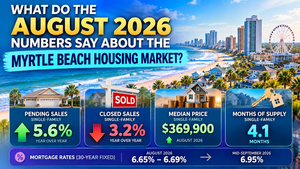
Zooming out to Horry County and the broader Coastal Carolinas, you can see the same theme of moderation instead of shock. For the 12‑month period ending January 2026, closed sales for single‑family homes across the Coastal Carolinas were up 3.6%, with a median price of 365,000, while condo prices slipped about 3.7% to 238,825. Market‑wide inventory increased about 3.1% over the year, with condo inventory up 6.6% and months’ supply at 3.9 for single‑family homes and 7.4 for condos. This lines up with national patterns where existing‑home sales picked up late in 2025 as mortgage rates eased, but price growth slowed and buyers gained more options.
What the February 2026 Numbers Mean for Myrtle Beach Buyers
For buyers focused on Myrtle Beach, Carolina Forest, or nearby Grand Strand communities, the current data points to more leverage—but only if you use it strategically. Carolina Forest single‑family resales closed around 468,000 in the latest update, a notable step down from the prior month, with sellers still receiving about 97.4% of list and inventory at roughly seven months of supply. That combination—higher prices than the broader region but a “balanced‑plus” level of inventory—means buyers can be selective on floor plan, upgrades, and location and still have room to negotiate on repairs or concessions. Condos and townhomes in Carolina Forest averaged around 209,000, with a list‑to‑sale ratio near 97.1% and about nine months of supply, signaling negotiation room but not desperation.
Across the Coastal Carolinas MLS, January 2026 showings data confirms that buyer interest remains active, especially around Myrtle Beach and Horry County. Myrtle Beach logged about 6,848 showings in January with buyer‑interest ratios around 2.3 showings per listing, while Conway, Carolina Forest, and North Myrtle Beach all posted healthy showing activity. At the same time, condos are clearly more inventory‑heavy, with 3,058 active condo listings and 7.4 months of supply at the start of 2026, compared to 3,586 single‑family listings and 3.9 months of supply. For buyers, this means the greatest negotiation power often sits in condo and oceanfront segments, while well‑priced single‑family homes in popular areas still attract steady attention.
New construction is another important piece of the buyer landscape in Myrtle Beach right now. In the February 2026 update, new homes across the Grand Strand closed at an average of about 446,000, with builders accepting roughly 98.2% of list price—slightly lower than recent months. About 33 buyers in the latest closing set received closing‑cost assistance, with incentives typically ranging between 3,000 and 17,000, showing that many builders are using targeted concessions instead of blanket price cuts. In a market where resale days on market are stretching well over 100 days in many segments, buyers looking at new construction can compare builder incentives to see where the best overall value (price plus concessions plus features) really lies.
What the February 2026 Numbers Mean for Myrtle Beach Sellers and Builders
For Myrtle Beach‑area sellers and those planning to build, the February 2026 data highlights how essential accurate pricing and strong marketing have become. Across the Coastal Carolinas, the percent of list price received over the last 12 months averaged about 97.3% for single‑family homes and 96.0% for condos, only slightly lower than a year earlier. That means buyers are not routinely securing 10–15% discounts; instead, overpriced listings sit while well‑priced homes still sell reasonably close to asking. With days on market trending in the 120–130‑day range across many price brackets, staging, photography, and online visibility play a bigger role in keeping your property from becoming “stale” compared to the rapid‑fire pace of 2021–2022.
In key Myrtle Beach and Grand Strand sub‑markets, long‑term price trends also show stabilization rather than a retreat back to pre‑pandemic levels. From 2021 to 2025, Horry County’s median price rose from 234,500 to 310,000—a gain of about 32%—and Myrtle Beach’s median still sits roughly 32% above 2021 despite a modest 5.3% dip between 2024 and 2025. Carolina Forest’s median climbed about 37.6% over the same four‑year window, while many coastal sub‑markets such as North Myrtle Beach and Pawleys Island‑Litchfield also show sizeable multi‑year appreciation. For sellers and builders, the implication is that pricing decisions should weigh this longer‑term equity growth against the current, more deliberate pace of showings and offers, rather than reacting to a single month’s pullback.
At the same time, affordability has improved modestly, which shapes how buyers respond to your price. The January 2026 Housing Affordability Index in the Coastal Carolinas rose to about 85 for single‑family homes and 129 for condos, up from the prior year, reflecting easing mortgage rates and slight price adjustments. Nationally, existing‑home sales rose 5.1% month‑over‑month and 1.4% year‑over‑year to a 4.35‑million unit pace heading into 2026, with the South showing stronger gains than other regions. That backdrop supports steady—but choosier—demand for Grand Strand properties, especially in well‑located Myrtle Beach neighborhoods and planned communities with modern layouts and energy‑efficient features.
How Buyers and Sellers Can Use This “Strategic Market”
Whether you are buying or selling in Myrtle Beach, the February 2026 numbers point toward strategy over speculation. Buyers can use longer days on market and higher months of supply, especially in condo and oceanfront segments, to negotiate repairs, closing costs, and move‑in timelines while still recognizing that high‑quality, well‑priced homes do not linger forever. Sellers and future new‑construction owners should lean on hyper‑local data by neighborhood and price range—Carolina Forest versus Conway, oceanfront condos versus inland townhomes—rather than assuming all of Horry County moves in lockstep. One practical approach is to compare list‑to‑sale price ratios and months of supply within your exact segment before setting a price or incentive package, then adjust quickly if early showings do not produce offers.
For those considering building a new home in Myrtle Beach, it helps to view the current environment as a window for careful planning instead of racing the market. Coastal Carolinas data shows that homes between 350,001 and 500,000 currently sell the fastest at around 120 days on market, while properties above 1,000,001 take closer to 141 days, so aligning your build’s price point with where demand is strongest can improve your eventual resale position. With pending sales up 1.5% year‑over‑year region‑wide and single‑family prices still modestly higher over the last 12 months, the 2026 story for Myrtle Beach looks more like stabilization than a cliff. In the words of the February Grand Strand update, “buyers have more options, sellers have more competition, and pricing correctly matters more than ever.”
Carolina Crafted Homes stays current on Myrtle Beach market trends and can answer questions about whether the Myrtle Beach market is crashing and what the February 2026 data means for you. Reach out anytime for guidance—no pressure, just straightforward expertise.
FAQs
Q1: Are Myrtle Beach home prices actually dropping in 2026?
Recent data shows moderation more than a sharp drop in Myrtle Beach‑area prices. Across the Coastal Carolinas, the 12‑month median single‑family price increased about 1.4% to 365,000 through January 2026, while the overall median across all property types edged down 0.9% to 327,000. Within the Grand Strand, the February 2026 update shows single‑family resale homes closing around 496,000 on average in January, down from December but still with sellers receiving about 95.9% of list price. That pattern reflects a cooler, more balanced market rather than a broad‑based price collapse.
Q2: Is now a good time to buy a condo or townhome in Myrtle Beach?
Condo and townhome buyers currently enjoy more leverage than they had a few years ago. Grand Strand condos closed around 251,000 in January with sellers receiving about 96.4% of list price, but inventory is roughly 9.5 months, which is firmly in buyer‑market territory. Region‑wide, condo inventory rose 6.6% over the past year and months of supply sits near 7.4. If you’re patient and focused on value rather than timing the bottom, this environment can be favorable for locking in a well‑located condo along the Grand Strand.
Q3: How competitive is the Myrtle Beach market for sellers right now?
Sellers face more competition than in the peak pandemic years, but well‑positioned listings still perform. Across the Coastal Carolinas, the average percent of list price received over the last 12 months is about 97.3% for single‑family homes and 96.0% for condos. Days on market are higher—averaging around 125 days across all price ranges—but that reflects normalizing conditions and increased inventory rather than buyer disappearance. In sub‑markets like Carolina Forest, seven months of supply for single‑family resales means pricing, presentation, and marketing strategy are crucial to stand out.
Q4: What do current showings and buyer activity look like in Horry County?
January 2026 showings data confirms that buyer activity remains solid across Horry County and the Grand Strand. Myrtle Beach logged about 6,848 showings with buyer‑interest ratios around 2.3 showings per listing, while Conway, Carolina Forest, North Myrtle Beach, and Pawleys Island all recorded strong traffic as well. For 2025 as a whole, there were more than 176,000 showings in Horry County and over 194,000 across the wider region, with Garden City/Murrells Inlet and Carolina Forest among the highest showings per listing. These figures indicate that the pool of buyers is still active; they’re simply more selective and price‑sensitive.
Q5: How does Myrtle Beach compare to national housing trends going into 2026?
Nationally, existing‑home sales rose 5.1% month‑over‑month and 1.4% year‑over‑year to an annual rate of 4.35 million units heading into January 2026. The South, which includes South Carolina, saw some of the strongest gains as mortgage rates eased and price growth slowed. Locally, the Coastal Carolinas region mirrors this “stabilization” theme: single‑family sales up 3.6% in 2025, modest price gains, and increased inventory that has shifted conditions toward a more balanced market, especially for condos. Myrtle Beach is tracking that national pattern—less frenzy, more negotiation—rather than diverging into a true crash scenario.
Q6: What does the current market mean for building a new home in Myrtle Beach?
For new construction, today’s numbers suggest a planning‑friendly environment rather than a race against rising prices. New homes across the Grand Strand recently averaged around 446,000, with builders accepting about 98.2% of list price and offering closing‑cost assistance to a subset of buyers, often between 3,000 and 17,000. Region‑wide, pending sales have increased 1.5% over the past year, and homes in the 350,001–500,000 range sell fastest at about 120 days on market. That combination allows Myrtle Beach buyers to compare build options and incentives carefully, while future resale demand remains supported by steady population growth and long‑term price gains in Horry County.