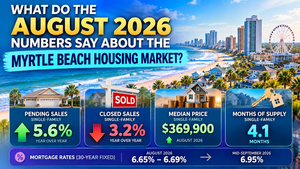
Many buyers entering the Myrtle Beach market in 2026 share a similar hesitation: “We’re ready — but we’re waiting for rates to drop.”
It’s an understandable instinct. Mortgage rates directly affect monthly payments, and even small changes can feel meaningful when you’re budgeting for a home purchase.
What often gets overlooked, however, is how waiting interacts with home prices, competition, and long-term cost. Data from national housing authorities shows that buyers who delay primarily for interest rate relief frequently end up paying more overall — not less. In the Grand Strand, where inventory remains constrained and demand stays steady, this dynamic is especially relevant.
This article breaks down why waiting for lower rates can quietly increase costs — and what buyers should evaluate instead when deciding when to purchase.
Mortgage Rates Matter — But Not in Isolation
Mortgage rates in early 2026 remain elevated compared to the ultra-low levels seen earlier in the decade, but they have stabilized relative to the volatility of 2024–2025. According to Freddie Mac, the average 30-year fixed mortgage rate has been fluctuating in a relatively narrow range over recent months.
The key takeaway isn’t whether rates drop another quarter point — it’s that rates are only one variable in affordability.
Buyers often focus on interest rates because they’re visible and easy to track. Home prices, by contrast, move gradually — but their impact compounds over time. As the National Association of Realtors has repeatedly noted in its housing research, affordability is driven by the combined effect of price, rate, taxes, and insurance — not rate alone.
A lower rate on a higher-priced home can still result in a higher payment.
The Hidden Cost of Waiting: Home Price Appreciation
One of the most common miscalculations buyers make is assuming prices will hold steady while they wait for rates to improve. Historically, that’s rarely the case — particularly in supply-constrained coastal markets.
Across much of the Grand Strand, resale inventory in 2026 remains below long-term norms. When fewer homes are available, prices tend to rise gradually even when rates remain flat.
Consider a simplified example:
A $350,000 home today
A 4% annual price increase
One year of waiting = ~$14,000 higher purchase price
Even if mortgage rates decline slightly during that period, buyers are financing more principal — which often offsets or exceeds any interest savings.
Research summarized by the Consumer Financial Protection Bureau shows that when rate declines lag behind price growth, overall borrowing costs increase for delayed buyers.
Why Rate Drops Often Bring More Competition
Another overlooked factor is what happens when rates do fall.
Lower rates don’t just help one buyer — they bring more buyers back into the market at the same time. That surge in demand frequently leads to:
Multiple offers
Reduced negotiation leverage
Higher contract prices
Fewer seller concessions
In markets like Myrtle Beach, where lifestyle-driven demand remains strong, even modest rate dips can trigger noticeable increases in buyer activity. The result is that buyers who waited may face more competition for fewer homes, often paying a premium to secure a property.
In practical terms, the benefit of a slightly lower rate can be erased by a higher purchase price or less favorable contract terms.
Monthly Payment vs. Long-Term Cost
It’s natural to anchor decisions to the monthly payment — but focusing only on that number can distort the bigger picture.
Waiting can increase costs in several ways:
Higher purchase price, increasing loan balance
Lost equity growth during the waiting period
Continued rent payments with no ownership return
Reduced choice, especially in lower-inventory segments
Even if a rate reduction lowers the monthly payment slightly, the buyer may still pay more over the life of the loan due to the higher starting price.
This is why housing economists often stress timing based on financial readiness, not rate prediction.
What Buyers Can Control Instead
While buyers can’t control the bond market or rate forecasts, there are steps that materially improve outcomes regardless of rate movement.
Get Fully Pre-Approved
A full pre-approval clarifies true buying power and positions buyers to act when the right property becomes available — without hesitation.
Shop Mortgage Options
Rate spreads between lenders and loan programs often exceed typical month-to-month market changes. Comparing options can reduce costs more reliably than waiting.
Evaluate Total Housing Cost
Insurance, taxes, HOA dues, and maintenance all factor into affordability. Looking at the full monthly picture leads to more durable decisions.
Plan for Flexibility
Refinancing remains an option if rates decline meaningfully in the future. Buying when financially prepared allows buyers to benefit from today’s prices and future rate adjustments.
Myrtle Beach Market Context in 2026
The Myrtle Beach and Grand Strand markets continue to reflect long-term population and second-home demand patterns. While sales volume has normalized from earlier highs, pricing has remained resilient due to limited resale supply and steady inbound interest.
For buyers waiting solely on rates, the local reality is this: price movement and competition are more predictable than rate relief. That makes waiting a strategy with measurable — and often underestimated — cost.
A More Practical Way to Think About Timing
Rather than asking “Will rates drop?”, a more useful question is:
“Am I financially prepared to buy a home that fits my needs at today’s prices?”
When the answer is yes, waiting introduces risks that often outweigh the potential reward. Buyers who act from a position of readiness — not prediction — tend to experience more stable outcomes over time.
If you’re evaluating whether buying now or waiting makes more sense based on your budget, price range, and financing options, having clear numbers matters more than guessing where rates go next. Understanding how today’s market conditions affect your long-term cost can help you move forward with confidence — whenever the timing is right for you.
FAQs
Is it better to wait for mortgage rates to drop before buying?
Waiting can seem logical, but buyers often face higher home prices and increased competition during that time. Even small price increases can outweigh modest rate improvements. Many buyers find that purchasing when financially ready — and refinancing later if needed — results in lower long-term costs than delaying for uncertain rate changes.
How much do interest rates actually affect affordability?
Interest rates influence monthly payments, but affordability is driven by the combination of price, rate, taxes, insurance, and loan structure. A lower rate on a higher-priced home may still cost more overall than buying sooner at a slightly higher rate.
Do home prices usually rise when rates fall?
Often, yes. Lower rates tend to bring more buyers into the market, increasing demand. In areas with limited inventory, this added competition can push prices up, reducing the benefit of lower rates for buyers who waited.
Can buyers refinance if rates drop later?
Refinancing is an option if rates decline meaningfully in the future. While not guaranteed, it allows buyers to benefit from future rate improvements without missing out on current prices or equity growth.
Is waiting safer in slower markets?
Even in slower markets, prices rarely move backward significantly unless inventory surges. Buyers should evaluate local supply, pricing trends, and personal financial readiness rather than relying on rate forecasts alone.