TL;DR: You won't find a single migration database that fully explains what's pulling buyers toward the Myrtle Beach area — but buyer behavior surveys and local MLS data together tell a clear story. The typical buyer today is older, increasingly motivated by proximity to family and lifestyle factors rather than job location, and showing up in active numbers across Horry County and the Grand Strand.
What the Data Actually Shows About Who Is Moving to South Carolina
The question "why are people moving to South Carolina in 2026" gets asked a lot online. It's a reasonable question. But the honest answer is that the most granular state-to-state migration datasets — the kind that would tell you exactly which metros are sending buyers to Horry County — aren't yet available for 2025 or 2026. What is available are two layers of data that tell a complementary story: national buyer behavior surveys that reveal why people move and who is moving long distances, and local MLS data that shows exactly what demand looks like on the ground here in the Grand Strand. Together, they make a coherent case.
The Buyer Profile the Data Keeps Describing
The national picture has shifted. According to the NAR 2025 Profile of Home Buyers and Sellers, the median age of all home buyers reached a record high of 59 in 2025 — up from 56 the prior year. The median repeat buyer came in at 62, also a record. Even first-time buyers hit a new high: the typical first-time buyer was 40 years old, up from 38 the year before.
This matters because an older buyer pool behaves differently. According to NAR (2025), 76% of recent buyers had no children under 18 in the home — the highest share ever recorded. School district proximity, which once drove neighborhood decisions, carries far less weight for this group. What's replaced it: neighborhood quality (cited by 59% of all buyers), proximity to friends and family (47%), and overall affordability (35%).
Meanwhile, convenience to a job ranked 31% — down from 52% in 2014. That's a decade-long, sustained decline. Whether the cause is remote work flexibility, an aging buyer pool, or both, the result is the same: today's buyers are increasingly making location decisions based on lifestyle and relationships, not commute distance.
Among sellers who moved 101 miles or more — the long-distance movers most likely to be relocating across state lines — NAR data shows 44% cited a desire to be closer to friends and family as their primary motivation, and 12% cited retirement. Nearly one in five veterans make up the broader buyer pool, at 18%, according to the same report — a segment with particular relevance to markets near military installations and VA-friendly coastal communities. If you're planning a move to the Myrtle Beach area from out of state, understanding how the process differs from an in-state purchase is a useful first step.
What Buyers Are Choosing When They Get Here
Size preferences are shifting as well. In the Coastal Carolinas market, closed sales of homes 3,001 square feet and above grew 8.5% in 2025 — the strongest growth of any size bracket tracked by CCAR MLS (Annual Report, 2025). Buyers seeking additional space for guests, home offices, or multi-generational living arrangements are making up a growing share of activity, particularly outside the core Myrtle Beach condo corridor.
According to the NAR 2025 Profile, buyers who choose new construction over existing homes most commonly cite the desire to avoid renovations or major repairs (48% of new-home buyers). That preference shows up clearly in the local data: across Horry County, 33.7% of all closed sales in 2025 involved new construction, per CCAR MLS Annual Report (2025). In fast-growing submarkets, that share runs considerably higher — Loris/Longs at 64%, Aynor at 49.4%, and Socastee and Carolina Forest each above 40%.
Nationally, the median buyer also expects to stay: the NAR 2025 Profile puts expected tenure at 15 years, with 28% saying they never plan to move. That's not the mindset of a speculative buyer. It's the mindset of someone making a long-term commitment to a place.
What the Grand Strand Market Data Confirms
Local numbers from CCAR MLS reinforce the picture of sustained, if measured, demand.
Horry County closed 16,796 sales in 2025, a modest +0.6% increase from 2024 (CCAR MLS Annual Report, 2025). The broader Coastal Carolinas market — encompassing Horry and Georgetown counties — recorded 16,128 closed sales, up 1.5%. The Horry County median sales price held at $310,000 in 2025, unchanged from 2024 but up 32.2% since 2021.
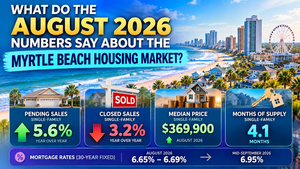
Early 2026 data shows the market gaining traction. According to CCAR Monthly Indicators (April 2026), pending single-family sales increased 11.2% year-over-year — a leading indicator of where closings are headed. The local Housing Affordability Index for single-family homes rose 5.1% year-over-year to 82 in April 2026, a modest but measurable improvement.
Showing activity — the ground-level signal of buyer interest — adds texture to that trend.
Grand Strand Buyer Activity — April 2026
Source: CCAR MLS Showings Report, April 2026 (current as of May 10, 2026)
| Area | Total Showings (Apr 2026) | Buyer Interest (Showings/Listing) |
|---|---|---|
| Myrtle Beach | 8,000 (+7.8% YOY) | 2.4 (+14.6% YOY) |
| North Myrtle Beach | 2,643 | 2.4 |
| Conway | 2,307 | 2.7 |
| Murrells Inlet | 1,739 | 3.1 |
| Little River | 1,404 | 2.6 |
| Surfside Beach | 913 (+18.6% YOY) | 3.4 (+30.2% YOY) |
| Pawleys Island | 878 | 3.2 |
| Longs | 772 | 2.0 |
Buyer interest is highest in Surfside Beach (3.4), Pawleys Island (3.2), and Murrells Inlet (3.1) — established coastal submarkets drawing consistent attention across multiple price brackets.
What This Means If You're Considering Building Here
The profile emerging from the data — older buyers, longer expected tenure, preference for new construction, declining attachment to job proximity — maps closely to what many buyers describe when they first contact a local builder. They're not in a hurry in the usual sense. They're making a considered decision about where they want to live for the long term, and they want a home built for that stage of life.
If you're weighing what it looks like to build in the Myrtle Beach area — what communities are active, what price points correspond to which finishes, and how the timeline compares to buying existing — the team at Carolina Crafted Homes builds throughout Horry County and can walk through specifics with you. Reach out to start the conversation.
FAQ SECTION
Q1: Why are people buying homes in South Carolina in 2026?
National buyer data points to several converging factors. According to the NAR 2025 Profile of Home Buyers and Sellers, the top motivations for long-distance movers include proximity to friends and family (44% of those moving 101+ miles) and retirement (12%). Markets like Myrtle Beach and the broader Grand Strand attract buyers who have more flexibility in where they live — a trend reinforced by the decade-long decline in job proximity as a top neighborhood priority, which now sits at 31%, down from 52% in 2014.
Q2: Who is typically buying homes in the Myrtle Beach area right now?
The typical buyer in the current market, both locally and nationally, is older than in previous decades. The NAR 2025 Profile reports the median buyer age hit a record 59, with repeat buyers at a median of 62. Three-quarters of recent buyers had no children under 18 in the home. Veterans represent 18% of the buyer pool nationally. These profiles align with the Grand Strand's appeal as a long-term destination rather than a transitional market.
Q3: Is buyer demand still strong in Horry County?
Yes, by multiple measures. CCAR MLS data shows Horry County recorded 16,796 closed sales in 2025, up 0.6% from 2024. In April 2026, pending single-family sales increased 11.2% year-over-year across the Coastal Carolinas — a leading indicator for closings. Showings in Myrtle Beach rose 7.8% year-over-year in April 2026, with buyer interest (showings per listing) up 14.6% in the same period.
Q4: How much of the market is new construction vs. existing homes?
New construction represents a significant share of local activity. Across the Coastal Carolinas MLS market in 2025, 36.1% of all closed sales involved new construction, per CCAR's Annual Report. In Horry County specifically, that figure was 33.7%. In high-growth corridors like Loris/Longs and Aynor, new construction represented more than half of all closed sales.
Q5: Are home prices in Myrtle Beach still rising?
Prices have stabilized compared to the rapid appreciation of 2021–2022. The Horry County median sales price held at $310,000 in 2025, unchanged from 2024 but still 32.2% above the 2021 level of $234,500, per CCAR MLS Annual Report (2025). As of April 2026, the single-family median price across the Coastal Carolinas market was $368,000, with the Housing Affordability Index rising 5.1% year-over-year — a modest improvement in purchasing power for buyers financing at current rates.
Q6: What size homes are buyers in the Grand Strand looking for?
Larger homes are gaining ground. According to CCAR MLS (Annual Report, 2025), closed sales of homes 3,001 square feet and above grew 8.5% in 2025 — the strongest growth of any size category in the market. Nationally, the NAR 2025 Profile shows a desire for more space as a top motivator for repeat buyers, with 76% of all buyers having no children under 18 in the home — a profile consistent with buyers seeking flex rooms, guest suites, or space for multi-generational arrangements.
Sources
Coastal Carolinas Association of REALTORS® MLS — 2025 Annual Report on the Coastal Carolinas Housing Market: https://www.ccarsc.org/pages/marketstats/
Coastal Carolinas Association of REALTORS® MLS — Monthly Indicators, April 2026: https://www.ccarsc.org/pages/marketstats/
Coastal Carolinas Association of REALTORS® MLS — Showings Report, April 2026: https://www.ccarsc.org/pages/marketstats/
National Association of REALTORS® — 2025 Profile of Home Buyers and Sellers: https://www.nar.realtor/
Moving to Myrtle Beach from Out of State in 2026: https://www.carolinacraftedhomes.com/blog/moving-to-myrtle-beach-from-out-of-state-2026