TL;DR: Out-of-state buyers are often surprised that the Grand Strand market moves slowly, leans heavily toward condos, and prices swing widely from one town to the next. Knowing how days on market, inventory, and property type vary helps relocators plan a smarter, less stressful move in 2026.
Moving to Myrtle Beach from out of state? Read this first.
Plenty of people picture one thing when they imagine the Grand Strand: a quick beach-town purchase at a single, tidy price. The data tells a more layered story. According to CCAR MLS (April 2026), single-family homes across the Coastal Carolinas region sat for a median of 125 days before selling, and the area carried 4.3 months of single-family supply. That is a far cry from the fast-moving markets many relocators are leaving. If you are moving here from another state, a few realities tend to catch people off guard — and each one is easier to handle once you see it coming.
How far buyers actually move — and why it matters here
Most home buyers do not go far. According to the NAR Profile of Home Buyers and Sellers (2025), the median distance between a buyer's new home and their previous one was just 20 miles. But a meaningful minority move much farther. Among sellers who bought again, a combined share of roughly 38 percent relocated 100 miles or more.
That long-distance group faces a different set of decisions. You can't pop by for a second showing. You may not know which towns fit your budget. And the reasons people give for these moves — being closer to family and friends (16 percent of all buyers) and retirement (7 percent) per NAR (2025) — often mean the move is permanent, so the choice carries weight. Treating a Grand Strand relocation like a local move is the first mistake to avoid.
The market moves slower than you might expect
Relocators from competitive metros tend to brace for bidding wars. The Grand Strand rarely works that way right now. According to CCAR MLS (April 2026):
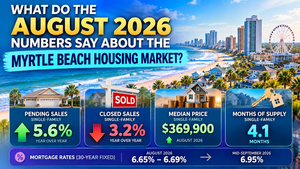
Single-family months supply sat at 4.3, and condo supply reached 8.1.
Single-family homes received a median of 97.6 percent of list price.
The regional Housing Affordability Index rose about 5 percent year over year.
In plain terms, buyers generally have room to negotiate and time to think. Inventory has been climbing rather than shrinking. That said, "slow market" does not mean "any offer wins" — well-priced homes in popular areas still move, and showing activity stays strong across Horry County. The takeaway: build a timeline that allows for patience instead of panic.
Prices and property types vary widely across the Grand Strand
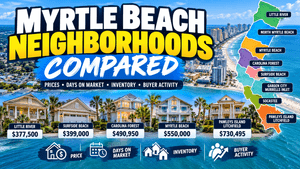
This surprises almost everyone. "Myrtle Beach prices" is not a single number — it shifts dramatically by town. According to CCAR MLS (2025 Annual Report), the 2025 median single-family price ranged from $260,000 in Myrtle Beach proper to $513,745 in Pawleys Island/Litchfield.
2025 Median Single-Family Sales Price by Area
| Area | 2025 Median Price | 1-Year Change |
|---|---|---|
| Myrtle Beach | $260,000 | - 5.3% |
| North Myrtle Beach | $407,950 | - 0.5% |
| Carolina Forest | $398,944 | + 3.6% |
| Conway | $306,472 | + 3.9% |
| Garden City / Murrells Inlet | $390,000 | + 4.0% |
| Pawleys Island / Litchfield | $513,745 | + 4.3% |
Source: CCAR MLS, 2025 Annual Report on the Coastal Carolinas Housing Market.
Property type catches people off guard too. According to CCAR MLS (2025 Annual Report), condos made up 73.3 percent of the Myrtle Beach market. So the "beach house near the water" many relocators imagine is often, in reality, a condo — with HOA fees and rules to match. Decide early whether you want a detached home, a townhome, or a condo, because that choice steers which towns and price points make sense.
Touring and buying from a distance
You probably can't drive over for every showing. That logistics gap trips up a lot of out-of-state buyers. Tools like virtual home tours and remote walkthroughs let you shortlist homes before booking a trip, so an in-person visit confirms a decision rather than starting one.
New construction is worth weighing too. According to the NAR Profile (2025), 12 percent of buyers purchased a newly built home, and 48 percent of those buyers did so to avoid renovations and repair headaches — a real advantage when you're managing a move from afar. According to the NAHB Construction Cost Survey (2024), the average new single-family home measured 2,647 square feet, with construction costs near $162 per square foot. Exploring available communities early helps you compare a move-in-ready build against an existing resale.
Costs relocators often forget to budget for
Beyond the purchase price, out-of-state buyers frequently underestimate ongoing carrying costs — property taxes assessed differently for primary residences versus second homes, and coastal property insurance. These line items can meaningfully change a monthly budget along the Grand Strand. Confirm current figures with a licensed professional for your specific situation and address before you finalize a budget.
Relocating to the Grand Strand is very doable — it just rewards planning over assumptions. If you're weighing a condo versus a detached home, a resale versus a new build, or simply trying to figure out which town fits your number, reach out to start the conversation. A grounded look at current data beats guessing from a thousand miles away.
FAQ SECTION
Is now a good time to move to Myrtle Beach from out of state? Conditions currently favor patient buyers. According to CCAR MLS (April 2026), the region carried 4.3 months of single-family supply and homes sold at a median of 97.6 percent of list price, signaling room to negotiate rather than a frantic seller's market. Timing depends on your personal finances and goals, not just the market. The data simply suggests relocators can take time to compare towns and property types before committing.
Why do homes in Myrtle Beach take so long to sell? Longer days on market are normal here. According to CCAR MLS (April 2026), single-family homes across the region sold in a median of 125 days, and in Myrtle Beach proper the figure was 117 days. A large share of condo inventory and seasonal buyer activity both contribute. For relocators, this means more time to evaluate options — and more negotiating leverage than fast-moving markets typically allow.
Are most Myrtle Beach properties condos or houses? Condos dominate the city itself. According to CCAR MLS (2025 Annual Report), condos made up 73.3 percent of the Myrtle Beach market. Surrounding areas like Carolina Forest and Conway skew more toward detached single-family homes. If you want a house rather than a condo, your search may center on those inland and outlying communities, which also tend to carry different price points and HOA structures.
How much does it cost to build a new home near Myrtle Beach? Building costs vary by lot, design, and finishes. As a national benchmark, the NAHB Construction Cost Survey (2024) reported the average new single-family home at 2,647 square feet, with construction costs around $162 per square foot. Local labor, land, and material prices differ, so this is a starting reference, not a quote. The Grand Strand typically tracks broader regional trends. A builder can provide figures specific to your plan and lot.
Can I buy a home in Myrtle Beach without visiting in person first? Yes, many out-of-state buyers begin remotely. Virtual tours and remote walkthroughs let you narrow choices before traveling, so an in-person visit confirms a decision instead of starting one. New construction can also simplify a long-distance purchase, since move-in-ready homes reduce the renovation and repair coordination that resales sometimes require.
Do prices really differ that much across the Grand Strand? They do. According to CCAR MLS (2025 Annual Report), the 2025 median single-family price ranged from $260,000 in Myrtle Beach to $513,745 in Pawleys Island/Litchfield. North Myrtle Beach sat at $407,950 and Conway at $306,472. Because "Myrtle Beach pricing" spans such a wide band, identifying your target town early keeps your budget realistic.
Sources
Coastal Carolinas Association of REALTORS® (CCAR MLS): https://www.ccarsc.org/pages/marketstats/
National Association of REALTORS® — Profile of Home Buyers and Sellers (2025): https://www.nar.realtor/
National Association of Home Builders — Construction Cost Survey (2024): https://www.nahb.org/news-and-economics/housing-economics-plus/special-studies/special-studies-pages/cost-of-constructing-a-home-in-2024