TL;DR: Not every corner of the Grand Strand is equally set up for people who work from home. Carolina Forest and Conway offer the space and value that suit a dedicated home office, while certain high-condo-density areas come with trade-offs worth knowing before you sign. Here's a data-driven look at where remote-friendly housing actually pencils out in 2026.
The Grand Strand Has What Remote Workers Want — But Location Still Matters
Something fundamental shifted in how buyers weigh location. According to the NAR Profile of Home Buyers and Sellers (2025), convenience to a buyer's job has dropped to just 31 percent of all buyers as a neighborhood priority — down from 52 percent in 2014. When proximity to an office becomes less important, what takes its place? Quality of the neighborhood (59 percent), convenience to friends and family (47 percent), and overall home affordability (35 percent) now lead the list.
That shift plays directly into why the Myrtle Beach area keeps drawing buyers who are no longer tied to a metro. The question for someone buying with a home office in mind isn't "how close is it to downtown?" It's "does this neighborhood give me the space, value, and quality of life to actually build a career here?"
The answer depends a lot on which part of Horry County — or the broader Grand Strand — you're looking at.
The Neighborhoods That Work Best for Remote Buyers
Carolina Forest: Space, Value, and a Market Moving Fast
If you need a dedicated home office and room to grow, Carolina Forest consistently delivers one of the strongest value propositions on the Grand Strand. According to CCAR MLS (April 2026), the median single-family sales price in Carolina Forest was $520,000 in April — up nearly 19.8% year-over-year — yet the area still closed at 98.3% of list price, one of the tightest ratios in the region. That combination signals strong demand without the kind of speculative froth that inflates prices beyond practical value.
What makes Carolina Forest well-suited to buyers prioritizing a home workspace? The area's housing mix skews heavily toward single-family detached homes with larger floor plans. CCAR MLS data (2025 Annual Report) shows Carolina Forest ranked among the top areas for showings per listing at 10.4 — meaning homes here attract serious buyers. Inventory has actually tightened (down 24% year-over-year through April 2026), which reflects ongoing demand from buyers who have done their homework.
The western portions of Carolina Forest sit further from the tourist corridor, meaning less seasonal traffic noise and more of the quiet you need on a Tuesday morning call.
Conway: The Affordability Anchor of the Region
For buyers where budget is the primary constraint, Conway offers the lowest median single-family price of any significant area on the Grand Strand. According to CCAR MLS (April 2026), the median single-family sales price in Conway held at $314,900 in April — essentially flat year-over-year. That stability matters. You're not fighting appreciation pressure while trying to qualify.
Conway's lot sizes tend to run larger than beachside communities, which directly translates into more interior square footage per dollar. The 2025 Annual Report data shows Conway had 108.8% growth in new condo listings from 2024, suggesting the market is becoming more diversified — which generally gives buyers more options at more price points.
One trade-off: days on market in Conway have been running 141 days for single-family homes (April 2026 CCAR MLS) — the longest of any area reviewed here. That's a buyers' market dynamic that actually works in your favor if you're negotiating.
Garden City / Murrells Inlet: Quieter, More Established
The Garden City and Murrells Inlet corridor is a different kind of fit. The 2025 Annual Report (CCAR MLS) ranked Garden City / Murrells Inlet second-highest in the region for showings per listing at 10.6 — indicating steady, sustained buyer demand that reflects real market confidence. As of April 2026, the median single-family price was $500,000 with a year-to-date figure of $461,375.
Buyers seeking a quieter setting with fewer seasonal crowds will find that the southern end of Horry County and into Georgetown County tends to feel less transient than areas directly on the tourist strip. That said, home prices are higher here, and inventory has remained relatively stable rather than growing.
The Areas That Can Drive You Crazy (And Why)
Downtown Myrtle Beach: Condo Inventory Is High for a Reason
Let's be direct. The Myrtle Beach core ZIP codes (29572 and 29577) carry a condo inventory profile that can be challenging for buyers who are looking for a primary workspace rather than a vacation asset. According to CCAR MLS (April 2026), condo inventory in Myrtle Beach sat at 1,475 units — up 5.8% year-over-year — with median condo prices down 12.4% year-over-year to $208,500.
That price drop isn't necessarily a buying opportunity — it often reflects the reality of high tourist-season noise, dense parking, and the kind of unit layouts that weren't designed for full-time home offices. The 2025 Annual Report noted Myrtle Beach accounted for 73.3% of the region's condo market share — the highest by far. Heavy condo concentration usually correlates with short-term rental activity and transient foot traffic. If you need a focused workspace for eight-plus hours a day, that environment creates friction.
North Myrtle Beach: Strong Prices, But Watch the Days on Market
North Myrtle Beach has seen robust single-family price appreciation — median of $560,000 in April 2026, up 10.7% year-over-year (CCAR MLS, April 2026). But days on market jumped 26.4% year-over-year to 134 days. When it takes that long to move a property, it often reflects buyer hesitation about value at that price point.
For buyers, longer days on market can mean more negotiating room. But it can also signal that the area's price trajectory is running ahead of what the broader buyer pool finds reasonable — which matters for long-term value and resale.
Grand Strand Neighborhood Comparison for Remote-Focused Buyers
Source: CCAR MLS Local Market Updates, April 2026 and 2025 Annual Report. Current as of May 10, 2026.
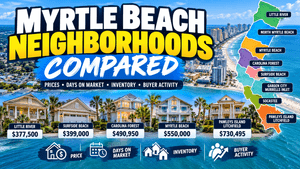
| Area | Median SF Price (Apr 2026) | Days on Market | YoY Price Change |
|---|---|---|---|
| Carolina Forest | $520,000 | 129 days | +19.8% |
| Conway | $314,900 | 141 days | +0.9% |
| Garden City / Murrells Inlet | $500,000 | 105 days | +2.7% |
| Myrtle Beach (Core) | $478,000 | 117 days | -10.2% |
| North Myrtle Beach | $560,000 | 134 days | +10.7% |
Choosing a Neighborhood Is Also Choosing a Floor Plan
One data point from the NAR Profile of Home Buyers and Sellers (2025) is worth holding onto: the median home purchased nationally was 1,900 square feet. For someone who needs a dedicated home office, that's a practical constraint — not just a preference. A 1,500-square-foot condo in a dense coastal corridor doesn't leave much room for a proper workspace.
That's why the floor plan conversation matters as much as the neighborhood conversation. Areas like Carolina Forest and Conway tend to have higher concentrations of larger single-family detached homes, which give buyers the square footage flexibility to build in a real office rather than work from a corner of the bedroom.
Buyers navigating this market for the first time — or returning after years away — may also find the free Grand Strand Buyer's Guide useful. It covers financing strategies, neighborhood breakdowns, and what to expect from contract through closing, all written specifically for the Myrtle Beach market.
For a deeper look at how individual Grand Strand submarkets are performing right now, the Myrtle Beach market by city breakdown for 2026 covers pricing and inventory trends across the full region. And if you're evaluating the broader decision to relocate to coastal South Carolina, this overview of why buyers are choosing the area in 2026 addresses the lifestyle and market factors driving that trend.
The Bottom Line for Buyers Buying With Work in Mind
There's no single answer that fits every situation. Carolina Forest suits buyers who want newer construction, larger floor plans, and strong resale fundamentals. Conway suits buyers who want the most purchasing power on the Grand Strand. Garden City and Murrells Inlet suit buyers who want established character and genuine quiet. The dense condo core of Myrtle Beach suits buyers whose primary goal is the beach — not a productive workday.
If you're trying to match the right neighborhood to your specific situation — floor plan needs, commute flexibility, price range, or build timeline — the team at Carolina Crafted Homes works exclusively in this market and can help you think through what actually matters for your search. Reach out here to start that conversation.
FAQ SECTION
Q1: Which Myrtle Beach neighborhood has the most affordable home prices for buyers seeking larger square footage?
Conway consistently offers the lowest median single-family prices on the Grand Strand. According to CCAR MLS (April 2026), the median single-family price there held at $314,900 — well below the regional average. Lots and floor plans in Conway also tend to run larger than beachside communities, which gives buyers who need a dedicated workspace more interior room per dollar spent.
Q2: Is Carolina Forest a good area to buy a larger home in 2026?
Carolina Forest has shown strong demand fundamentals in 2026. CCAR MLS data (April 2026) shows a median single-family sales price of $520,000, closing at 98.3% of list price — one of the tightest ratios in the region. Inventory has tightened considerably (down 24% year-over-year through April 2026), reflecting sustained buyer interest in the area's larger-format single-family homes.
Q3: Why is condo inventory in the Myrtle Beach core so high in 2026?
According to CCAR MLS (April 2026), condo inventory in the core Myrtle Beach ZIP codes stood at 1,475 units — up 5.8% year-over-year — with median prices down 12.4%. The area's heavy condo concentration (73.3% condo market share per the 2025 Annual Report) reflects a market heavily influenced by short-term rental and vacation demand, which historically results in more volatile pricing than suburban single-family markets.
Q4: How important is proximity to work for today's home buyers?
Less important than it used to be. According to the NAR Profile of Home Buyers and Sellers (2025), only 31% of buyers now cite convenience to their job as a neighborhood factor — down from 52% in 2014. Neighborhood quality (59%) and convenience to friends and family (47%) rank far higher. That shift reflects the growing share of buyers whose work arrangements provide more location flexibility.
Q5: Does it take longer to sell a home in some Grand Strand areas than others?
Yes, significantly. As of April 2026, days on market ranged from 105 days in Garden City/Murrells Inlet to 141 days in Conway (CCAR MLS, April 2026). Longer days on market in a given area typically gives buyers more negotiating leverage, while shorter days on market — as seen in Garden City/Murrells Inlet — reflects tighter competition among buyers.
Q6: What's the median distance buyers are moving when purchasing a home in 2025?
According to the NAR Profile of Home Buyers and Sellers (2025), the median distance between a buyer's previous residence and their new home was 20 miles — down from the 50-mile peak seen in 2022 during the remote work surge, but still elevated above the 15-mile norm seen from 2018 to 2021. That suggests long-distance relocation remains more common than it was pre-pandemic.
Sources
Coastal Carolinas Association of REALTORS® MLS — 2025 Annual Report on the Coastal Carolinas Housing Market: https://www.ccarsc.org/pages/marketstats/
Coastal Carolinas Association of REALTORS® MLS — Local Market Update, April 2026: https://www.ccarsc.org/pages/marketstats/
Coastal Carolinas Association of REALTORS® MLS — Showings Report, April 2026: https://www.ccarsc.org/pages/marketstats/
National Association of REALTORS® — Profile of Home Buyers and Sellers 2025: https://www.nar.realtor/