TL;DR: Florida's "no income tax" reputation only tells part of the story. When you factor in property tax rates, Florida's documentary stamp tax on real estate transfers, and the state's insurance market pressures, South Carolina's Grand Strand often comes out ahead on total cost of ownership — even with a state income tax on the books.
Florida's lack of a state income tax has made it a magnet for relocating households for decades. But a closer look at 2026 tax data tells a more nuanced story. According to Tax Foundation (2026), Florida's overall tax competitiveness ranks 5th nationally, while South Carolina ranks 29th — yet property tax burdens, real estate transfer costs, and insurance pressures shift the picture considerably once a specific purchase is on the table. For buyers comparing the Grand Strand to Florida markets, understanding where each state actually gains or loses ground matters more than a single headline stat. This post breaks down income tax, property tax, closing-cost differences, and interstate migration patterns using Tax Foundation, Florida Department of Revenue, Florida Office of Insurance Regulation, and CCAR MLS data.
Myrtle Beach vs. Florida Cost of Living: Where the Numbers Land
Florida's biggest cost advantage is well known: the state levies no individual income tax, according to Tax Foundation (2026). South Carolina, by contrast, applies a graduated income tax with a top marginal rate of 6%, per the same source. That difference matters most for higher earners, but it isn't the whole tax picture.
When Tax Foundation (2026) measures each state's overall tax competitiveness — factoring in corporate, individual income, sales, property, and unemployment insurance taxes together — Florida ranks 5th nationally, while South Carolina ranks 29th. At the same time, property taxes make up a larger share of Florida's total state and local tax burden (34.8%) than South Carolina's (29.9%), according to Tax Foundation (2026). Corporate tax rates run close: Florida taxes corporate income at 5.5% and South Carolina at 5%, per Tax Foundation (2026).
For Grand Strand buyers, the takeaway is that "no income tax" doesn't automatically mean "lowest total tax burden." The comparison depends heavily on income level, property value, and how a household actually spends and owns.
Property Taxes: A Real Gap Between Horry County and Florida's Coast
Effective property tax rates show one of the clearest differences between the two markets. Horry County's effective property tax rate sits at 0.38%, with a 2024 median property tax bill of $944, according to Tax Foundation's county-level property tax data. Comparable Florida coastal counties run notably higher: Volusia County at 0.78%, Duval County at 0.75%, Brevard County at 0.68%, and Palm Beach County at 0.82%, per the same source.
On a $325,000 home, that difference is significant over time. A 0.38% effective rate produces a materially smaller annual bill than a 0.75%–0.85% rate on a comparable purchase price — a gap that compounds year over year for Grand Strand homeowners priced against a Florida coastal alternative.
Florida also applies a documentary stamp tax on real estate transfers that doesn't have a direct South Carolina equivalent. Per the Florida Department of Revenue, the tax rate on deeds transferring real property is $0.70 per $100 of consideration paid (Miami-Dade County uses a separate rate for single-family transfers). On a $400,000 sale, that's roughly $2,800 due at closing — a cost South Carolina buyers and sellers don't encounter in the same form.
Myrtle Beach Home Prices in the Current Market
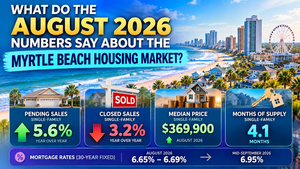
Local pricing adds another layer to the comparison. The median sales price across the CCAR MLS was $324,473 for the trailing 12 months ending June 2026, essentially flat compared to the prior year, according to CCAR MLS (June 2026). Median price per square foot came in at $159, and the median percent of last list price received was 97.7%, per the same source — indicating a market where sellers are receiving close to asking price but pricing has largely stabilized.
That price stability, paired with Horry County's comparatively low effective property tax rate, positions the Grand Strand as a market where total carrying costs are relatively predictable — a meaningful factor for buyers weighing markets with more volatile insurance and tax exposure.
Insurance Costs: Florida's Market Under Pressure
Florida's property insurance market carries costs that factor directly into total cost of ownership. According to the Florida Office of Insurance Regulation (data as of July 2026), the admitted market average homeowner's premium is $3,757 including wind coverage, or $2,586 excluding wind. The state has 7.64 million residential insurance policies in force, and 1,883,487 policies were approved for Citizens Property Insurance Corporation "takeout" in 2025 alone — reflecting the scale of Florida's insurer-of-last-resort dependency, per the same source.
| Cost Factor | South Carolina | Florida |
|---|---|---|
| Individual Income Tax | Graduated, top rate 6% | None |
| Property Tax Share of Tax Burden | 29.9% | 34.8% |
| Effective Property Tax Rate (coastal county example) | 0.38% (Horry County) | 0.68%–0.84% (Brevard, Duval, Volusia, Palm Beach) |
| Corporate Income Tax | 5% | 5.5% |
| Overall Tax Competitiveness Rank | 29th | 5th |
Source: Tax Foundation (2026); effective property tax rates reflect 2024 data.
Migration Patterns: What the Data Shows About Households Choosing South Carolina
South Carolina posted the highest per-capita net migration gain of any state in the country, according to Tax Foundation's 2026 analysis of migration data, with a net population gain of roughly 59,100 people and a net adjusted gross income gain of about $4.1 billion. Horry County reflects that trend locally: the county gained a net 11,232 residents through migration, with the vast majority — a net 11,386 people and roughly $739.6 million in net AGI — arriving from other states rather than elsewhere within South Carolina, per the same source.
That data confirms strong inbound migration to the Grand Strand broadly. It doesn't, on its own, isolate how much of that inflow originated specifically in Florida — a distinction worth keeping in mind when evaluating relocation trends rather than assuming a single dominant origin state.
Comparing Myrtle Beach to a Florida market involves more moving pieces than a single tax rate. Between property tax rates, transfer costs at closing, and insurance market conditions, the full financial picture takes some work to piece together — and it looks different depending on income level, home price, and how long you plan to stay. If you're weighing a move to the Grand Strand and want to talk through what these numbers mean for a specific budget or floor plan, get in touch and we can walk through it together.
FAQ
Is it cheaper to live in Myrtle Beach than in Florida?
It depends on income and property value. Florida has no state income tax, which benefits higher earners, but South Carolina has a lower effective property tax rate in Horry County (0.38%) compared to many Florida coastal counties (0.68%–0.84%), per Tax Foundation (2026). Florida also adds a documentary stamp tax at closing that South Carolina doesn't have in the same form.
Does Florida really have no state income tax?
Yes. Florida is one of a small number of states with no individual income tax, according to Tax Foundation (2026). South Carolina has a graduated income tax with a top marginal rate of 6%. This is one of Florida's most significant cost advantages for high-income households.
Are property taxes lower in South Carolina than Florida?
In Horry County specifically, yes. The effective property tax rate is 0.38%, compared to 0.68%–0.84% across several Florida coastal counties, based on 2024 data from Tax Foundation. Property tax rates vary by county in both states, so this isn't universal across all of Florida.
Why are people moving to South Carolina?
South Carolina had the highest per-capita net migration gain of any U.S. state, according to Tax Foundation's 2026 migration data analysis. Horry County specifically gained a net 11,232 residents through migration. The data doesn't break out how much of that came from any single origin state, including Florida.
What is Florida's documentary stamp tax, and does South Carolina have something similar?
Florida charges $0.70 per $100 of consideration on real estate deed transfers, per the Florida Department of Revenue. South Carolina doesn't apply an equivalent transfer tax in the same structure, which can make closing costs on a comparable sale price different between the two states. Consult a licensed professional to confirm current costs for a specific transaction.
Is home insurance cheaper in Myrtle Beach than in Florida?
Florida's admitted market average homeowner's premium is $3,757 including wind coverage, according to the Florida Office of Insurance Regulation (data as of July 2026). A directly comparable South Carolina average wasn't available in current approved sources for this comparison — see the Data Gaps section below.
Sources
Tax Foundation (2026): https://taxfoundation.org
Florida Department of Revenue, Documentary Stamp Tax (GT-800014): https://floridarevenue.com
Florida Office of Insurance Regulation, Market Overview: https://floir.gov/property-casualty/market-overview
CCAR MLS Mid-Year 2026 Report: Project file (Coastal Carolinas Association of REALTORS®)