TL;DR: The buyers arriving in the Myrtle Beach and Grand Strand area in 2026 are increasingly long-distance movers — repeat buyers with equity to spend, drawn by proximity to family, lower costs of living, and a lifestyle that no longer requires them to stay tethered to a high-cost metro. Understanding who's coming, and why, helps you compete more effectively in this market.
Why Myrtle Beach Keeps Attracting Out-of-State Buyers
Myrtle Beach has never been a secret. But the profile of the buyer choosing the Grand Strand in 2025 and into 2026 has shifted in ways worth understanding if you're navigating this market.
According to the NAR 2025 Profile of Home Buyers and Sellers, the median age of all buyers nationally reached a record high of 59, with repeat buyers averaging 62. These are not first-time buyers stretching to make a down payment. They're people who have spent years building equity in a primary home — often in a higher-cost state — and are now making a deliberate, long-range move.
Among sellers who moved more than 100 miles from their previous home, retirement was a primary driver for 12 percent, and job relocation accounted for 13 percent. But the single strongest reason, cited by 44 percent of long-distance movers, was the desire to be closer to friends and family.
That pattern fits the Grand Strand well. South Carolina has long attracted buyers from the Northeast, Mid-Atlantic, and Midwest who have personal or family ties to the region. The data reinforces what local real estate professionals observe on the ground: this isn't just a retirement migration. It's a broader lifestyle reorientation that spans a range of ages and motivations.
What's Bringing Buyers Here: The Pull Factors in 2026
Several forces are drawing buyers specifically to the Myrtle Beach area rather than other Sun Belt destinations.
Affordability relative to origin markets. According to CCAR MLS data (2025 Annual Report), the median sales price for single-family homes in the Coastal Carolinas region was $365,000 — meaningfully below median prices in the Northeast and Mid-Atlantic metros where many incoming buyers are originating. For a buyer selling a home in a high-cost market and arriving with substantial equity, the value equation in Horry County is compelling.
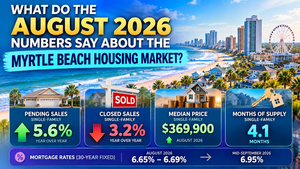
A market that's active, not overheated. The 12-month period through April 2026 showed pending sales in the CCAR region up 4.1 percent overall, per CCAR MLS data. The single-family segment is holding steady, with a median sales price of $365,000 and 4.3 months of inventory — conditions that support thoughtful decision-making rather than panic buying.
The convenience-to-job factor is declining — and that matters here. According to the NAR 2025 Profile, just 31 percent of buyers nationally still name job proximity as a key neighborhood factor, down from 52 percent in 2014. That shift removes one of the primary obstacles to relocating far from a current metro. As work flexibility has expanded for many buyers, the geographic anchor that once kept them in place has weakened.
According to the NAR February 2026 REALTORS® Confidence Index, 34 percent of agents reported buyers actively searching for work-from-home features in February 2026 — and 87 percent of buyers that month purchased in a suburban, small town, rural, or resort area. That's the profile of a Myrtle Beach buyer.
The Buyer Who's Actually Arriving
The repeat buyer profile dominates the Grand Strand's inbound migration picture.
According to NAR 2025 data, repeat buyers have a median down payment of 23 percent, and 30 percent pay cash outright. Their median household income is $111,700. They're not stretching — they're executing a planned transition, often after 11 years in a previous home (the current national median tenure, also an all-time record high).
For these buyers, the move to the Myrtle Beach area is rarely impulsive. According to the NAR 2025 Profile, 19 percent of sellers in 2025 purchased a home in a different region than where they sold — a figure that captures the cross-regional flow feeding markets like the Grand Strand.
The desire to be closer to friends and family was the top motivation for long-distance movers, at 44 percent. Retirement followed at 12 percent. These motivations reflect a buyer who has made a considered lifestyle decision — not someone chasing a hot market. That matters for builders and sellers, because this buyer tends to know what they want and often searches for longer before committing.
According to CCAR MLS (2025 Annual Report), 36.1 percent of all closed sales in the Coastal Carolinas region were new construction in 2025. That's a significant share, and it reflects exactly the kind of buyer arriving from out of state: someone who wants a home built to current specifications, without the deferred maintenance risks of an older property. New construction communities across Horry County — from Conway to Loris/Longs to Carolina Forest — are capturing this demand. Conway posted 5.5 percent growth in closed sales in 2025, while Loris/Longs saw a 22.8 percent increase.
What This Means If You're Buying in the Grand Strand Right Now
Table: Grand Strand Area Closed Sales Performance, 2025 Source: CCAR MLS 2025 Annual Report on the Coastal Carolinas Housing Market (January 2026)
| Area | 2025 Closed Sales | Change from 2024 | New Construction % |
|---|---|---|---|
| Loris / Longs | 1,790 | +22.8% | 64.0% |
| Conway | 2,435 | +5.5% | 20.1% |
| Socastee | 1,575 | +5.5% | 41.4% |
| Carolina Forest | 1,582 | -7.5% | 42.4% |
| North Myrtle Beach | 1,746 | +10.8% | 16.1% |
| Garden City / Murrells Inlet | 1,216 | +4.1% | 20.1% |
If you're an inbound buyer evaluating where to plant roots in the Grand Strand, understanding which communities are growing — and why — gives you better footing. Areas with higher new construction concentrations, like Loris/Longs and Socastee, often offer more choices at accessible price points for buyers arriving without the constraint of a local job requirement. The communities available through Carolina Crafted Homes reflect exactly this range — from established areas to emerging corridors where new builds are reshaping Horry County.
If you're weighing the full picture of the Grand Strand's growth trajectory, the South Carolina growth and Myrtle Beach 2026 overview provides useful context on what's driving demand at a broader level.
If you're relocating to the Myrtle Beach area and trying to understand how the market will affect your options — whether you're trading equity from a previous home or navigating new construction for the first time — it helps to talk with a builder who works in this market every day. The buyer profile in the Grand Strand is specific, and the process has its own rhythms. Explore the Buyers Guide for an overview of what to expect, or reach out to the team at Carolina Crafted Homes to start a conversation about what fits your situation.
FAQ SECTION
Q1: Where are most people moving from when they relocate to Myrtle Beach? According to the NAR 2025 Profile of Home Buyers and Sellers, 19 percent of sellers nationally purchased a home in a different region from where they sold. For the Grand Strand specifically, inbound buyers commonly originate from the Northeast, Mid-Atlantic, and Midwest — markets where home prices are significantly higher and where many buyers have built equity over a decade or more. The desire to be closer to friends and family was cited by 44 percent of long-distance movers as their top reason for selling. Note: Horry County–specific origin state data is not available in current approved sources; the national trend is the best available proxy.
Q2: Is Myrtle Beach still affordable compared to where most buyers are coming from? For many inbound buyers, yes. According to CCAR MLS data (2025 Annual Report), the median single-family sales price in the Coastal Carolinas region was $365,000 in 2025. Buyers arriving from higher-cost metros with significant equity often find that the Grand Strand offers substantially more home for their money. That dynamic continues to support demand across Horry County's new construction communities.
Q3: What's drawing buyers to Horry County communities outside of Myrtle Beach proper? Areas like Loris/Longs, Conway, and Socastee posted strong sales growth in 2025 — up 22.8%, 5.5%, and 5.5% respectively, per CCAR MLS data. These communities offer higher concentrations of new construction (Loris/Longs at 64.0% new construction share in 2025), larger lots, and price points that appeal to buyers who aren't anchored to a specific commute route. As the convenience-to-job factor declines in importance — now at just 31% of buyers nationally per NAR 2025 data — more buyers have the flexibility to choose based on lifestyle and value.
Q4: How long are most buyers searching before buying in the Myrtle Beach market? Nationally, the median home search took 10 weeks in 2025, according to the NAR 2025 Profile of Home Buyers and Sellers. For long-distance relocating buyers, who often cannot tour frequently in person, that timeline can stretch. The same NAR data shows that 6 percent of buyers in February 2026 purchased based on a virtual tour or showing alone — a sign that remote buyers are increasingly comfortable transacting from a distance.
Q5: Are most Grand Strand buyers paying cash or financing? Nationally, cash buyers represented 31 percent of sales in February 2026 per the NAR REALTORS® Confidence Index. Repeat buyers — who make up the dominant buyer type in markets like the Grand Strand — had a median down payment of 23 percent in 2025, and 30 percent paid cash entirely. These are well-capitalized buyers, which partly explains why new construction continues to perform in this market even as affordability challenges persist at the entry level.
Q6: Is 2026 a good time to buy in the Grand Strand, given the uncertainty in the national market? Current data shows the Coastal Carolinas market moving toward stabilization. According to CCAR MLS data (April 2026 Housing Supply Overview), pending sales in the region rose 4.1 percent over the prior 12-month period, with single-family inventory at 4.3 months — a reasonably balanced supply level. The 2025 CCAR Annual Report noted that 2026 is expected to be a year of stabilization and recovery rather than dramatic swings. Consult with a licensed real estate professional for guidance specific to your situation.
Sources
Coastal Carolinas Association of REALTORS® MLS — 2025 Annual Report on the Coastal Carolinas Housing Market: https://www.ccarsc.org/pages/marketstats/
Coastal Carolinas Association of REALTORS® MLS — Housing Supply Overview, April 2026: https://www.ccarsc.org/pages/marketstats/
National Association of REALTORS® — 2025 Profile of Home Buyers and Sellers: https://www.nar.realtor/
National Association of REALTORS® — February 2026 REALTORS® Confidence Index Survey: https://www.nar.realtor/