TL;DR: Whether you owe capital gains tax on a Myrtle Beach condo sale depends mostly on how you used the property. A primary residence can qualify for a large federal exclusion, but a second home or rental usually cannot. South Carolina taxes the gain as income while allowing a 44% deduction on long-term gains, and out-of-state sellers may face withholding at closing.
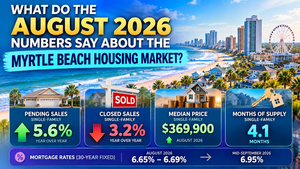
Selling a condo along the Grand Strand looks simple until tax season arrives. The Myrtle Beach condo market has cooled recently: the median townhouse/condo sale price landed at $208,500 in April 2026, down 12.4% from a year earlier, according to the CCAR Local Market Update (April 2026). A softer market changes the size of your profit, and your profit is exactly what the IRS and South Carolina look at. Before you list, it helps to know when a sale triggers tax and when it does not. The rules turn on how you used the unit and how long you owned it.
Do You Pay Taxes on Condo Sale Profit in Myrtle Beach?
Your taxable profit is not the same as your check at closing. The IRS taxes your capital gain, which is the sale price minus your adjusted basis. Your basis usually includes the original purchase price, qualifying improvements, and many selling costs.
Three factors decide whether that gain is taxed:
How you used the condo. A main home, a second home, and a rental each follow different rules.
How long you owned it. Property held more than one year gets long-term treatment. Property held a year or less is taxed as ordinary income, per IRS Topic No. 409.
Your income level. Long-term gains fall into 0%, 15%, or 20% brackets based on taxable income, again under IRS Topic No. 409.
Many Grand Strand condos serve as vacation units or rentals rather than primary homes. That single fact often decides the tax question. If the condo was never your main residence, the gain is generally taxable in full.
The Primary Residence Exclusion — and When a Condo Misses It
Federal law offers a valuable break for a main home. Under IRS Publication 523, you may exclude up to $250,000 of gain if you file single, or up to $500,000 if you are married filing jointly. To qualify, you must have owned the home and lived in it as your main residence for at least two of the five years before the sale.
Here is where many Myrtle Beach condo sellers get tripped up. A beach unit you rented out or used a few weeks a year rarely meets the use test. When that happens, the exclusion does not apply, and the gain is taxable.
Rentals add another layer. If you claimed depreciation, part of your gain may face depreciation recapture, taxed at a rate up to 25% under IRS Publication 544. Higher-income sellers may also owe the 3.8% Net Investment Income Tax once modified adjusted gross income passes $200,000 for single filers or $250,000 for joint filers, according to IRS Topic No. 559.
South Carolina Capital Gains Tax on a Condo Sale
South Carolina treats capital gains as regular income, but it softens the blow. The state allows a 44% deduction on net long-term capital gains, which lowers the amount subject to state tax, per SCDOR guidance. You can read more in our overview of the South Carolina 44% capital gains exclusion.
Out-of-state owners face an extra step at closing. Under SCDOR Form I-290, a buyer paying a nonresident seller must withhold on the sale. For individuals, the withholding equals South Carolina's top marginal individual income tax rate for the year; for corporations, the rate is 5%. The amount applies to the gain when the seller files an affidavit of gain (Form I-295), or to the total amount realized when no affidavit is provided.
This withholding is a prepayment, not a final bill. Sellers report the sale on a South Carolina income tax return and claim credit for the amount withheld, as the I-290 instructions explain. This article is general information, not tax advice. Consult a licensed tax professional or attorney about your specific situation.
Myrtle Beach Condo Values in 2026
Your gain depends on today's prices, and the Grand Strand condo market varies widely by area. In Myrtle Beach proper, condos sat on the market a median of 142 days and inventory rose 5.8% year over year in April 2026, according to the CCAR Local Market Update (April 2026). Across the entire MLS, the median sale price held near $324,473 in the twelve months ending June 2026, per CCAR mid-year 2026 data.
The table below compares recent median condo prices across nearby submarkets.
Grand Strand median townhouse/condo sale prices — April 2026
| Area | Median Condo Price (Apr 2026) | Year-Over-Year Change |
|---|---|---|
| Myrtle Beach | $208,500 | -12.4% |
| North Myrtle Beach | $342,900 | +8.9% |
| Surfside Beach | $176,000 | +0.6% |
| Garden City / Murrells Inlet | $302,215 | +0.8% |
| Pawleys Island / Litchfield | $330,000 | +27.5% |
| Little River | $141,250 | -32.7% |
Source: CCAR Local Market Update (April 2026).
Prices shape your gain, but your tax outcome still rests on how you used the unit. If you are weighing a sale and want a clear picture of your likely proceeds and next steps, our team can walk you through the local market and connect you with the right professionals. Start the conversation whenever you are ready to map out your options.
FAQ SECTION
Do you pay taxes on condo sale profit in Myrtle Beach?
It depends on how you used the condo and how long you owned it. If the unit was your main home for at least two of the last five years, you may exclude up to $250,000 of gain (single) or $500,000 (married filing jointly) under IRS Publication 523. A second home or rental generally does not qualify, so the gain is usually taxable. Profit is measured as the sale price minus your adjusted basis, not your total closing check.
How does South Carolina tax capital gains on a condo sale?
South Carolina treats capital gains as regular income but allows a 44% deduction on net long-term gains, which lowers the taxable amount, per SCDOR guidance. That deduction applies to property held more than one year. Short-term gains do not receive the deduction. Your final state tax depends on your total income and filing details, so a licensed tax professional can confirm the exact figure for your situation.
I live out of state. Will tax be withheld at closing?
Often, yes. Under SCDOR Form I-290, a buyer purchasing from a nonresident seller must withhold on the sale. For individuals, the amount equals South Carolina's top marginal individual income tax rate for the year; corporations use 5%. It applies to your gain if you file an affidavit of gain, or to the full amount realized if you do not. This is a prepayment, and you claim credit for it on your South Carolina income tax return.
Does the primary residence exclusion apply to a vacation condo?
Usually not. The exclusion requires that you owned and used the condo as your main residence for at least two of the five years before the sale, according to IRS Publication 523. Many Grand Strand condos are used seasonally or rented out, which fails the use test. When a unit does not qualify, the full gain is generally taxable, subject to long-term or short-term rates.
What if I rented the condo and claimed depreciation?
Depreciation you claimed can trigger depreciation recapture when you sell. Under IRS Publication 544, this portion may be taxed at a rate up to 25%. Higher-income sellers might also owe the 3.8% Net Investment Income Tax once income passes $200,000 (single) or $250,000 (joint), per IRS Topic No. 559. Rental sales get complicated quickly, so professional guidance is worthwhile.
Does a softer condo market lower my tax bill?
It can. Your tax is based on gain, not sale price. In Myrtle Beach, the median condo price fell 12.4% year over year to $208,500 in April 2026, according to the CCAR Local Market Update (April 2026). A smaller gap between your basis and your sale price means a smaller gain, and possibly less tax. If you sell at a loss on an investment property, different rules may apply.
Sources
CCAR Local Market Update (April 2026): https://www.ccarsc.org/pages/marketstats/
Coastal Carolinas Association of REALTORS® (mid-year 2026 MLS data): https://www.ccarsc.org/pages/marketstats/
IRS Publication 523 — Selling Your Home: https://www.irs.gov/publications/p523
IRS Topic No. 409 — Capital Gains and Losses: https://www.irs.gov/taxtopics/tc409
IRS Publication 544 — Sales and Other Dispositions of Assets: https://www.irs.gov/publications/p544
IRS Topic No. 559 — Net Investment Income Tax: https://www.irs.gov/taxtopics/tc559
SCDOR — Capital Gains Deduction guidance (44% long-term deduction): https://dor.sc.gov/
SCDOR — Form I-290, Nonresident Real Estate Withholding: https://dor.sc.gov/forms-site/Forms/I290.pdf
South Carolina 44% Capital Gains Exclusion (2026): https://www.carolinacraftedhomes.com/blog/south-carolina-44-percent-capital-gains-exclusion-2026
Capital Gains Tax on a South Carolina Home Sale (2026): https://www.carolinacraftedhomes.com/blog/capital-gains-tax-south-carolina-home-sale-2026
Selling a Second Home in South Carolina — Tax Guide (2026): https://www.carolinacraftedhomes.com/blog/selling-second-home-south-carolina-tax-2026
Myrtle Beach Condo vs. Single-Family Home Prices (2026): https://www.carolinacraftedhomes.com/blog/myrtle-beach-condo-vs-single-family-home-prices-2026
Myrtle Beach Oceanfront Condo Renovation (2026): https://www.carolinacraftedhomes.com/blog/myrtle-beach-oceanfront-condo-renovation-2026