TL;DR: 55+ and active adult communities around Myrtle Beach differ in their rules, fees, and home design, not just in their amenities. Compare recorded covenants, HOA costs, floor plans, and flood zone before you compare prices. Current CCAR MLS data shows single-family medians from about $311,000 to $570,000 across Grand Strand areas, so location shapes your budget.
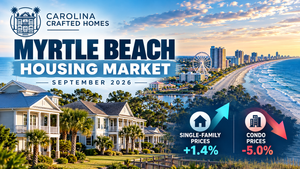
Planned communities with clubhouses, pools, and walking trails are a big part of how the Grand Strand is growing. The brochure rarely explains what you are actually agreeing to, though. According to CCAR MLS (September 2026), the regional median single-family sales price reached $370,000, up 1.4% from a year earlier. Single-family inventory held at 4.2 months of supply, which gives buyers room to compare. Financing matters too. FRED data shows the 30-year fixed mortgage rate at 6.95% as of September 17, 2026. This guide covers how to compare 55+ and active adult communities in Myrtle Beach on the factors that still matter long after move-in day.
55+ vs. Active Adult Communities: What the Labels Mean
In Horry County, these two labels often get used interchangeably. They are not always the same thing.
Age-restricted (55+) communities carry a formal occupancy designation written into the community’s recorded covenants. Federal fair housing law allows a narrow exemption for communities that meet specific requirements, and those rules govern occupancy.
Active adult communities usually describe an amenity package and a home design style. Many have no recorded occupancy restriction at all.
The difference affects you in three practical ways:
Resale. A recorded restriction shapes who can buy your home later.
Occupancy. Rules may limit long-term guests or who can live in the home.
Rule changes. Covenants usually include an amendment process controlled by owners or the HOA board.
The label also tells you little about the homes. Some neighborhoods offer single-level floor plans throughout. Others mix two-story homes into the same streets.
Don’t rely on an entrance sign or a listing remark. Ask for the recorded declaration, bylaws, and current rules and regulations. Read them before you sign a contract, or have a South Carolina real estate attorney review them. Requirements vary by community, so consult with a licensed professional for your specific situation.
How to Compare Myrtle Beach Retirement Communities
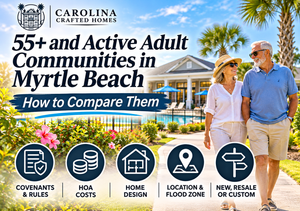
Once you understand the designation, line communities up side by side. A simple checklist keeps the comparison focused on facts instead of amenity photos.
Governing documents
Recorded occupancy designation, if any
Rental and short-term rental limits
Architectural review rules for additions, fences, and exterior changes
HOA costs
Current dues and how often they’re billed
What dues cover: lawn care, exterior upkeep, clubhouse, pools, gated access
Reserve fund balance and any planned special assessments
How dues have changed over the past several years
Home design
Primary bedroom on the main level
Zero-step entries and wider doorways
Walk-in showers and lever-style hardware
Garage size and storage space
Location and land
Drive time to the beach, shopping, medical offices, and Myrtle Beach International Airport
Flood zone designation for the specific lot
Flood zones deserve a closer look, especially if you want a zero-step entry. According to Horry County Government’s Build Responsibly guidance (accessed July 2026), new buildings in an AE flood zone in unincorporated Horry County must sit with the lowest floor at least 3 feet above base flood elevation. That height can mean steps or a ramp at the front door. City of Myrtle Beach, North Myrtle Beach, and Surfside Beach set their own rules.
Request the same documents from every community so you can compare evenly. What a community won’t provide tells you something too.
What Grand Strand Market Data Shows Right Now
CCAR MLS reports don’t break out sales by individual community. Area-level medians still give you a reliable price frame, since most planned communities sit inside these market areas.
Median prices by Grand Strand area, year to date (January–September 2026):
| Market Area | Single-Family Median | Townhouse/Condo Median | Single-Family Days on Market |
|---|---|---|---|
| Myrtle Beach (29572, 29577) | $522,500 | $205,000 | 131 |
| North Myrtle Beach (29582) | $569,995 | $310,000 | 120 |
| Carolina Forest (Area 10B) | $480,000 | $194,500 | 113 |
| Garden City / Murrells Inlet (29576) | $471,500 | $296,000 | 111 |
| Surfside Beach (29575) | $415,000 | $175,000 | 119 |
| Socastee (29588) | $360,000 | $195,000 | 116 |
| Little River (29566) | $350,000 | $196,000 | 119 |
| Conway (29526, 29527) | $311,000 | $224,385 | 133 |
Source: CCAR MLS Local Market Update (September 2026), year-to-date figures through September 2026.
The data points to three useful patterns:
Price spreads are wide. Conway’s year-to-date single-family median sits near $311,000. North Myrtle Beach runs close to $570,000.
Smaller homes offer more choice. According to CCAR MLS Housing Supply data (September 2026), single-family homes with two bedrooms or fewer had 6.0 months of supply. Three-bedroom homes had 3.8 months. The smaller homes carried a 12-month median price of $240,000.
Condos move more slowly. Region-wide condo supply stood at 7.5 months, with a September median of $230,125 (CCAR MLS, September 2026).
Rates shape the monthly cost of any of these options. FRED data shows the 30-year fixed rate at 6.95% on September 17, 2026, compared with 6.26% on September 18, 2025. Programs and rates subject to change; verify current details.
Planned Community, Resale, or Custom Build
A planned community is one path, not the only one. National buyer data helps explain why people choose new construction.
According to the NAR Profile of Home Buyers and Sellers (2025), buyers who chose a new home cited these reasons most often:
Avoiding renovations or plumbing and electrical problems (43%)
The ability to choose and customize design features (22%)
Amenities of new home construction communities (17%)
Buyers who chose a previously owned home most often cited better overall value (32%). The same report found buyers expect to stay in their homes for a median of 15 years. Over that span, the layout you choose matters as much as the clubhouse.
Here’s how the three main paths compare:
New construction in a planned community. You get a set amenity package and set floor plans, with limited room to customize.
Resale in an established community. You get mature landscaping and a known HOA track record. Updates may be needed.
Custom build on your own lot. You design a single-level layout, wider doorways, and an entry plan from the start. HOA rules depend on where the lot sits.
For a broader look at new construction options, see our guide to new construction communities in Myrtle Beach.
Comparing communities comes down to details in the covenants, the HOA budget, and the floor plan, not the clubhouse photos. If you’re weighing a planned community against a custom single-level home on your own lot, we can walk you through the trade-offs, from flood zone elevation to entry design and layout. When you’re ready to compare options, start the conversation with our team.
FAQ
What is the difference between a 55+ community and an active adult community in Myrtle Beach?
A 55+ community carries a formal occupancy designation recorded in its covenants, and federal fair housing law sets specific requirements for communities that use it. An active adult community usually describes an amenity package and home design style, and many have no recorded occupancy restriction. In Horry County, the labels often overlap in marketing, so the entrance sign isn’t enough. Ask for the recorded declaration, bylaws, and current rules, and have a South Carolina real estate attorney review them. Consult with a licensed professional for your specific situation.
How much do homes cost in Myrtle Beach retirement communities?
CCAR MLS doesn’t report prices by individual community, but area medians give a solid frame. According to CCAR MLS (September 2026), year-to-date single-family medians ranged from about $311,000 in Conway to $569,995 in North Myrtle Beach, with the city of Myrtle Beach at $522,500. Townhouse and condo medians ran roughly $175,000 to $310,000, depending on area. Single-family homes with two bedrooms or fewer had a 12-month median of $240,000. Pricing inside any one community depends on the lot, floor plan, and amenity package.
What should I ask about HOA fees in an active adult community?
Ask what the dues are, how often they’re billed, and exactly what they cover. Some communities include lawn care, exterior maintenance, gated access, and clubhouse operations. Others cover common areas only. Request the current budget, the reserve fund balance, any planned special assessments, and the dues history for the past several years. Comparing these documents side by side shows the true monthly cost better than the dues figure alone.
Can I build a single-level home instead of buying in a planned community?
Yes. A custom build on your own lot lets you plan a single-level layout, wider doorways, walk-in showers, and the entry design from the start. Lot location matters. In unincorporated Horry County, the county’s Build Responsibly guidance requires the lowest floor in an AE flood zone to sit at least 3 feet above base flood elevation. That affects how you design a step-free entry. HOA rules depend on whether the lot sits inside a community with recorded covenants.
Do flood zones matter in Myrtle Beach active adult communities?
They do, for both design and cost. Flood zone designation sets elevation requirements and shapes how a home meets the ground. Horry County’s Build Responsibly guidance sets elevation rules for AE, VE, and A zones in unincorporated areas. City of Myrtle Beach, North Myrtle Beach, and Surfside Beach apply their own codes. Check the flood zone for the specific lot, not just the community, and ask for an elevation certificate on any existing home.
How do 2026 mortgage rates affect buying in a 55+ community?
Rates shape the monthly cost no matter which community you choose. FRED data shows the 30-year fixed rate at 6.95% as of September 17, 2026, up from 6.26% on September 18, 2025. On the same purchase price, a higher rate means a higher monthly payment. HOA dues and the rate together set your true carrying cost. Programs and rates subject to change; verify current details with a licensed lender.
Sources
Coastal Carolinas Association of REALTORS® (CCAR MLS: Monthly Indicators, Housing Supply Overview, Local Market Update, September 2026): https://www.ccarsc.org/pages/marketstats/
FRED Economic Data (MORTGAGE30US): https://fred.stlouisfed.org/
National Association of REALTORS® (2025 Profile of Home Buyers and Sellers): https://www.nar.realtor/
Horry County Government (Build Responsibly): https://horrycountysc.gov/
Living in Myrtle Beach: Is It the Right Fit? (2026): https://www.carolinacraftedhomes.com/blog/is-myrtle-beach-good-place-to-retire-2026
Cost of Living in Myrtle Beach (2026): https://www.carolinacraftedhomes.com/blog/cost-of-retiring-myrtle-beach-2026
Myrtle Beach Housing Demand Trends (2025): https://www.carolinacraftedhomes.com/blog/senior-boom-myrtle-beach-housing-trends-2025
Forever-Home and Multi-Generational Design in Coastal SC: https://www.carolinacraftedhomes.com/blog/forever-home-coastal-sc-aging-in-place-multi-gen-2025
Best New Construction Communities in Myrtle Beach (2026): https://www.carolinacraftedhomes.com/blog/best-new-construction-communities-myrtle-beach-2026
Explore Our Communities: https://www.carolinacraftedhomes.com/communities