TL;DR: Building a home in South Carolina comes down to five decisions: budget, lot, flood and permit rules, build type, and timeline. New construction made up more than a third of 2025 closed sales across the Coastal Carolinas, so building is a common path here. This guide walks through each step and links to a deeper guide on every topic.
New construction is a major part of the coastal South Carolina market. According to CCAR MLS (2025 Annual Report), 36.1% of closed sales across the region were new construction. In Horry County, the share was 33.7%. That makes building a mainstream option, not a niche one.
Still, building has more moving parts than buying a resale home. You choose a lot, check its flood zone, secure permits, pick a build type, and plan financing around a longer schedule. This hub page lays out each step in order. Every section links to a detailed guide, so you can go deeper wherever your plans need it.
Building a Home in South Carolina: The 2026 Market Picture
Before you price a build, it helps to know the resale market. Your new home will be measured against existing homes on price, size, and timing.
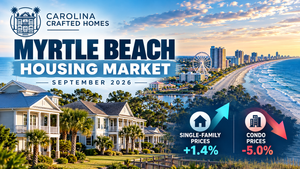
According to CCAR MLS (September 2026), the rolling 12-month median sales price for single-family homes was $363,734, up 0.2% from a year earlier. The all-property median, which includes condos, fell 1.5% to $325,000.
Supply has held fairly steady across the Grand Strand:
Single-family inventory: 3,855 active listings at the end of September 2026, down 3.5% year over year
Months of supply: 4.2 months for single-family homes
Days on market: 122 days on average from listing to accepted offer for single-family homes
Source: CCAR MLS Housing Supply Overview (September 2026).
Financing deserves extra attention on a build, since construction schedules can stretch across several months. According to FRED (September 2026), the 30-year fixed mortgage rate averaged 6.95% for the week of September 17, 2026. That compares with 6.26% for the same week in 2025. Programs and rates subject to change; verify current details.
The takeaway: resale prices are roughly flat, and buyers have choices. That gives you room to plan a build carefully and compare it against homes already on the market.
What It Costs to Build a House in South Carolina
A new home’s price covers much more than lumber and labor. National survey data shows how the total typically splits.
According to the NAHB Construction Cost Survey (January 2025, reflecting 2024 builds), construction made up 64.4% of the average sales price. The finished lot accounted for 13.7%. Construction averaged about $162 per square foot, the highest in the survey’s history.
Where the Price of a New Home Goes (NAHB 2024 National Averages)
| Cost Component | Average Amount | Share of Sales Price |
|---|---|---|
| Total construction cost | $428,215 | 64.4% |
| Finished lot (incl. financing) | $91,057 | 13.7% |
| Builder profit | $72,971 | 11.0% |
| Overhead and general expenses | $38,248 | 5.7% |
| Sales commission | $18,955 | 2.8% |
| Financing cost | $10,220 | 1.5% |
| Marketing cost | $5,633 | 0.8% |
| Total sales price | $665,298 | 100% |
Source: NAHB Construction Cost Survey (January 2025), 2024 national results.
Keep in mind these are national averages from 2024. NAHB notes its sample is too small to break results out by region. Local labor, land prices, and site conditions in Horry County can move your numbers in either direction. Coastal site work, such as elevating a home in a flood zone, may add costs a national average doesn’t capture.
Government fees are part of the bill, too. In the same NAHB survey, building permit fees averaged $7,640 per home, and impact fees averaged $6,367. Horry County’s own fee schedule will set your actual amounts.
For a closer look at budgeting line by line, see our guide to the cost to build a house in South Carolina.
Lots, Flood Zones, and Permits in Horry County
Your lot shapes almost every decision that follows. Elevation, drainage, and soil affect foundation design, cost, and what the county will approve. Our lot selection guide covers what to check before you buy land.
Start with the flood zone. According to Horry County Government’s Build Responsibly guidance (July 2026), unincorporated Horry County sets these elevation rules:
AE zone: lowest floor at least 3 feet above base flood elevation
VE zone: bottom of the lowest horizontal structural member at least 3 feet above base flood elevation
Zone A without a set base flood elevation: lowest floor at least 24 inches above the highest adjacent grade
In AE and VE zones, a “finished construction” elevation certificate must verify the height. Our Horry County flood zone requirements guide explains each zone in detail.
Permits come next. According to Horry County Government (July 2026), unincorporated areas require a permit for any construction or improvement costing more than $500, including materials and labor. Our Horry County building permits guide walks through the process.
One important note: these rules cover unincorporated Horry County. Myrtle Beach, North Myrtle Beach, and Surfside Beach each set their own codes. Confirm which jurisdiction your lot sits in before you plan. Consult with a licensed professional for your specific situation.
Choosing a Build Type and Planning Your Timeline
With a budget and a lot in place, two questions remain. How much design control do you want, and how long can your schedule flex?
Most coastal builds fall into three categories:
Custom: you design the home around your lot and priorities
Semi-custom: you start from an existing plan and adjust layout or finishes
Production: you choose from set plans, with limited changes
Each option trades some flexibility for price and schedule predictability. Our guide to custom, semi-custom, and production homes in coastal SC compares them side by side.
Floor plan size is part of that choice. Current data shows steady activity in larger homes. According to CCAR MLS (September 2026), pending sales of homes with four or more bedrooms rose 5.7% over the prior 12 months. Buyers seeking larger floor plans can weigh that activity when deciding on size.
Timelines vary with permitting, site work, weather, and inspections. Elevated foundations in flood zones add steps, such as the elevation certificate before final approval. Current CCAR and county data don’t publish a local average build time. Ask any builder for a written schedule with clear milestones. Our guide on how long it takes to build a new home in South Carolina breaks down each phase.
To see how these steps fit together from first meeting to move-in, review our home building process.
Every build starts with the same questions: what fits your budget, what your lot allows, and which flood and permit rules apply. With single-family supply at 4.2 months and rates just under 7% as of September 2026, a clear plan helps you compare building against buying resale. If you’re weighing a lot or a build type in Horry County, start the conversation with our team.
FAQ
How much does it cost to build a house in South Carolina?
Costs depend on the lot, home size, and site conditions. National data offers a starting point. According to the NAHB Construction Cost Survey (January 2025), construction averaged about $162 per square foot in 2024, and the average new home sold for $665,298 including the lot. Those are national figures, and NAHB notes they don’t break out by region. In Horry County, flood zone elevation, foundation type, and local fees can shift your total. Get a written, itemized estimate from your builder before you commit to a lot.
Do I need a building permit in Horry County?
Yes, in most cases. According to Horry County Government (July 2026), unincorporated Horry County requires a permit for any construction or improvement costing more than $500, including materials and labor. Homes inside city limits, such as Myrtle Beach, North Myrtle Beach, or Surfside Beach, follow that city’s own permit rules instead. Confirm your lot’s jurisdiction first. Horry County Code Enforcement can answer county questions at 843-915-5090. Consult with a licensed professional for your specific situation.
How high does a new home have to be built in a flood zone?
It depends on the zone. In unincorporated Horry County, homes in AE zones need the lowest floor at least 3 feet above base flood elevation. In VE zones, the bottom of the lowest horizontal structural member must sit at least 3 feet above base flood elevation. In Zone A areas without a set base flood elevation, the lowest floor must be at least 24 inches above the highest adjacent grade. These rules come from Horry County Government (July 2026). A finished construction elevation certificate verifies the height in AE and VE zones.
Is new construction common in the Myrtle Beach area?
Yes. According to CCAR MLS (2025 Annual Report), new construction made up 36.1% of closed sales across the Coastal Carolinas region in 2025. In Horry County specifically, the share was 33.7%. That means roughly one in three homes sold was newly built. For buyers, it signals a wide range of build options, from fully custom homes to set plans. It also means new homes and resale homes often compete for the same buyers on price and features.
How long does it take to build a new home in South Carolina?
Build times vary with permitting, lot preparation, weather, inspections, and the type of home. Homes in flood zones may need extra steps, such as an elevation certificate before final approval. Current CCAR MLS and Horry County data don’t publish a local average build time, so a builder’s written schedule is your best guide. Ask for clear milestones from permit to final inspection, and ask how the builder handles weather delays. Our timeline guide breaks down each phase in more detail.
Is it better to build or buy a resale home in Myrtle Beach?
It depends on your budget, timeline, and how much control you want over design. Resale homes let you move sooner. According to CCAR MLS (September 2026), the median single-family price was $363,734, with 4.2 months of supply. Building takes longer but lets you choose your lot, layout, and finishes, and meet current flood elevation rules from the start. Compare the full cost of each path, including financing. Rates averaged 6.95% for the week of September 17, 2026, per FRED. Rates subject to change; verify current details.
Sources
Coastal Carolinas Association of REALTORS® (CCAR MLS): https://www.ccarsc.org/pages/marketstats
NAHB Construction Cost Survey: https://www.nahb.org/news-and-economics/housing-economics-plus/special-studies/special-studies-pages/cost-of-constructing-a-home-in-2024
Horry County Government: https://horrycountysc.gov/
FRED Economic Data: https://fred.stlouisfed.org/
Cost to Build a House in South Carolina: https://www.carolinacraftedhomes.com/blog/cost-to-build-a-house-south-carolina-myrtle-beach-2026
How Long It Takes to Build a New Home in South Carolina: https://www.carolinacraftedhomes.com/blog/how-long-to-build-new-home-south-carolina-2026
Horry County Building Permits Guide: https://www.carolinacraftedhomes.com/blog/horry-county-building-permits-myrtle-beach-2026
Horry County Flood Zone Requirements for New Construction: https://www.carolinacraftedhomes.com/blog/horry-county-flood-zone-new-construction-requirements-2026
Custom vs. Semi-Custom vs. Production Homes in Coastal SC: https://www.carolinacraftedhomes.com/blog/custom-semi-custom-production-coastal-sc
Lot Selection: Elevation, Drainage, Soil, and Code: https://www.carolinacraftedhomes.com/blog/lot-selection-builders-elevation-drainage-soil-code
Our Home Building Process: https://www.carolinacraftedhomes.com/building-process